

Blog
How to Stay Visible While Running

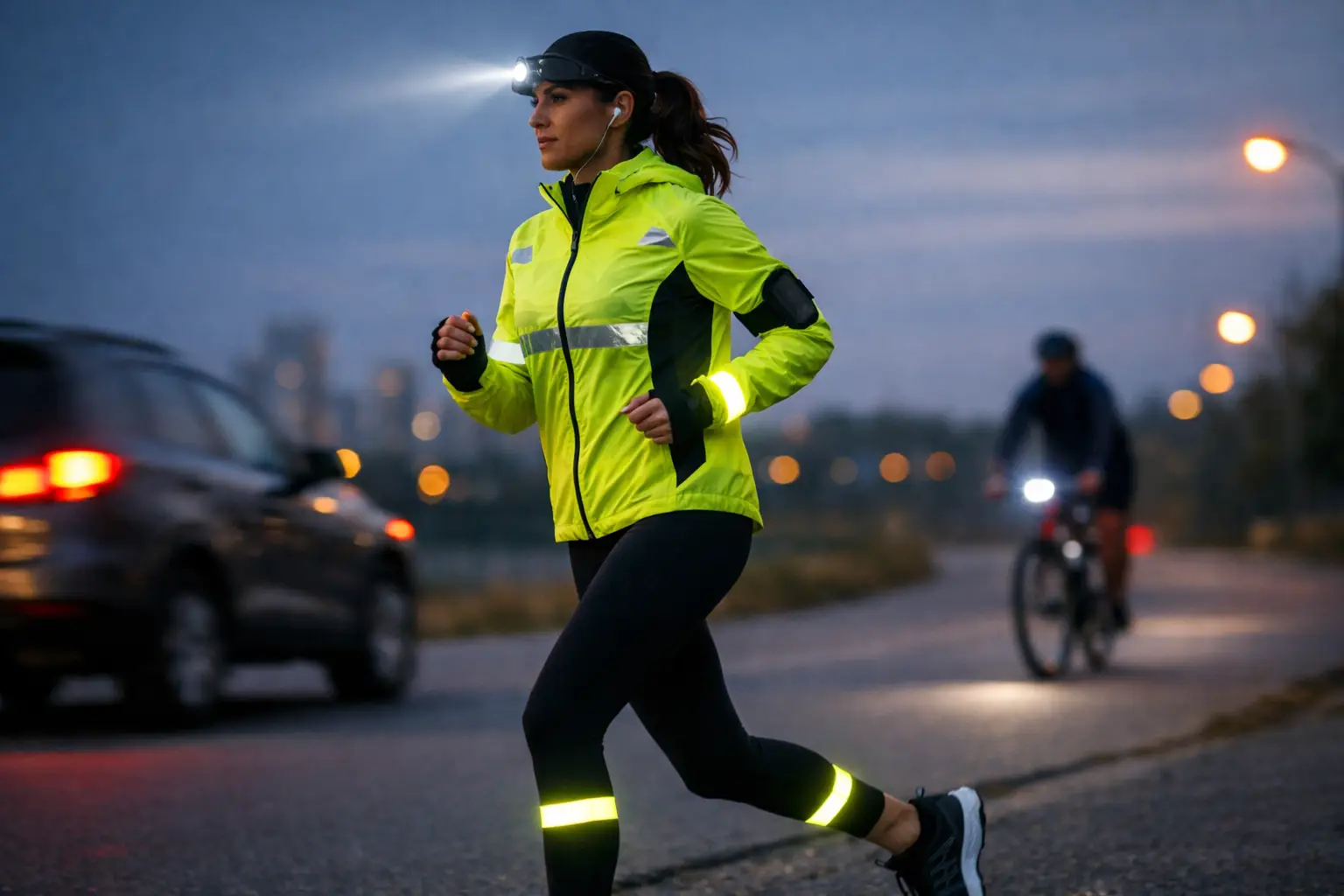
A black top, dark leggings and a quick five miles after work can make you almost disappear at the exact time roads get busier. That is why knowing how to stay visible while running matters so much. Visibility is not just about being seen eventually. It is about being recognised early enough for a driver, cyclist or pedestrian to react calmly and give you space.
For most runners, the risk window is ordinary. Early mornings before sunrise. Winter evenings. Wet commutes. Tree-lined lanes. Urban routes where car headlights bounce off shiny surfaces and make movement harder to judge. You do not need to be training for an ultra or heading into the countryside for visibility to become a real safety issue. If you run regularly, especially in autumn and winter, this is part of your kit plan.
Why visibility while running is more than reflective strips
A lot of runners think one reflective detail on a jacket solves the problem. It helps, but it is only one layer of visibility. Reflective material works when light hits it, so it is excellent when cars approach with headlights on. It does far less on unlit stretches, in poor weather, or in places where the angle of light is wrong.
That is where active lighting comes in. A chest light, head torch or LED strap creates its own visibility rather than waiting for someone else to light you up. The best approach is usually not reflective or illuminated. It is both.
There is also a difference between being visible and being identifiable. A tiny reflective logo may technically catch light, but it does not always help others understand that you are a runner moving forward at speed. Larger reflective areas on your torso, arms or ankles create a more recognisable pattern. That gives people around you more time to process what they are seeing.
How to stay visible while running in low light
If you want a practical answer to how to stay visible while running, start with the parts of your body that move most and the places people are most likely to see first.
Your torso is the obvious place to begin. Reflective vest straps or a lightweight high-visibility layer make your body outline easier to pick up from a distance. They are simple, effective and easy to wear over gear you already own, which matters if you are trying to avoid buying a whole extra wardrobe for one season.
Then think about motion. Reflective details on ankles, calves and arms are often more useful than runners expect because movement catches attention faster than a static block of colour. A driver may miss a dark jacket against a dark hedge, but the swing of a lit or reflective limb is much harder to ignore.
Finally, use an active light source. A rechargeable chest light works well because it sits at body level and makes you visible from the front without forcing all the weight onto your head. A head torch gives you the extra benefit of lighting the path ahead, which is particularly useful on uneven pavements, park paths or country lanes. If you choose one, look for a beam that helps you see clearly without dazzling everyone coming the other way.
Bright colours help – but they are not enough
Daylight visibility and night visibility are not the same thing. Fluorescent yellow, orange or pink can stand out brilliantly at dawn, in drizzle or on grey mornings. Once it gets properly dark, though, bright colours lose a lot of their value unless they are paired with reflective material or LEDs.
That does not mean colour is pointless. It means colour works best as part of a system. In daylight or transitional light, bright kit increases contrast against roads, trees and buildings. In darkness, reflective and illuminated details take over. If you run at different times of day, it makes sense to have gear that covers both rather than relying on one trick.
This is also where durability matters. Reflective prints that crack after a few washes or cheap lights that lose charge halfway through a run are not bargains. They are disposable problems. Better running gear should hold up through repeated use, because safety kit is only useful if you trust it enough to wear it every time.
Where to place lights for the best effect
More light is not always better. Smarter placement is better.
A head torch is excellent for seeing where you are going, especially on darker routes. It can also make you visible from the front, but the beam moves with your head. That is useful on trails and mixed terrain, less so if you want a steady, obvious point of light for road users to track.
A chest light gives a more stable forward-facing signal and usually feels less distracting once you settle into your stride. It is often a strong choice for road running because it sits in a natural line of sight for approaching traffic. If you run in areas with poor street lighting, combining a chest light with reflective vest straps is a strong setup.
Rear visibility matters too. Many runners focus only on what is in front of them, but traffic often approaches from behind. If your route includes roads, crossings or shared paths, make sure there is some reflective or illuminated detail visible from the back. A simple reflective harness or rear-facing LED can make a real difference.
Weather changes the visibility problem
Rain, fog and winter glare complicate everything. Wet roads reflect headlights. Windscreens mist up. Street lighting becomes patchy and distorted. In those conditions, your normal setup may need an upgrade.
If it is raining, reflective surfaces still help, but active lighting becomes much more important. In fog, larger reflective panels and brighter lights improve your chance of being picked up early, though even then drivers may be closer before they notice you. That is a good night to simplify your route, avoid narrow roads and stay on well-lit streets where possible.
Cold weather creates another issue. Runners often add dark outer layers in winter because they are practical and easy to match. Fair enough, but if your base layer has high-visibility details and your outer layer hides all of them, your visibility has dropped. Before you head out, check what is actually visible once all your layers are on.
Route choice is part of staying visible
Kit matters, but route choice is a safety decision too. The best reflective gear in the world cannot fully compensate for a blind bend, a poorly lit crossing or a lane with no pavement.
Whenever possible, choose routes with consistent lighting, wider sight lines and fewer awkward junctions. Residential streets can be safer than fast main roads, even if they add a minute or two. Shared paths and park loops can work well, but only if they are lit and busy enough to feel predictable. Quiet does not always mean safe if nobody can see you.
It also helps to think about contrast. Running beside a row of parked cars, through heavy shadow or under dense tree cover makes you harder to spot. Crossing points are another key area. Make eye contact where you can, slow slightly if a situation looks uncertain, and never assume reflective gear gives you priority in someone else’s attention span.
The common mistakes runners make
The biggest mistake is treating visibility as seasonal. Yes, winter is the obvious time to think about it, but low sun, rain and gloomy mornings can create poor visibility all year round.
The second is assuming one small reflective detail does the job. It rarely does. You need a visible outline, some movement cues and, in darker conditions, an active light source.
The third is forgetting comfort. If a vest bounces, a torch slips or a strap rubs, many runners quietly stop using it. The best visibility gear is the gear you will actually wear on a wet Tuesday when motivation is already low. Practical design wins every time.
Build a visibility setup you will use every run
A good system does not need to be complicated. For many runners, it starts with a bright top for daytime or low-light runs, reflective vest straps for 360-degree visibility, and a rechargeable chest light or head torch for darkness. Add a few reflective details lower down the body and you have something much more effective than a single high-vis item thrown on at the last minute.
This is also a good place to be honest about your routine. If most of your runs happen before work or after dinner, visibility is not an occasional extra. It is core kit, just like trainers that fit properly or layers that do not chafe. Buying fewer, better pieces that last is usually the smarter move for your safety, your comfort and the planet.
That is the bigger point. Running gear should earn its place. It should help you move confidently, hold up over time and solve a real problem instead of becoming another short-lived purchase. Brands like 4R are pushing that standard for a reason.
If you run when the light is low, make visibility non-negotiable. Make it easy, make it reliable, and make it part of the routine before you step out the door.