

Blog
Best Running Lights for Winter Road Runs

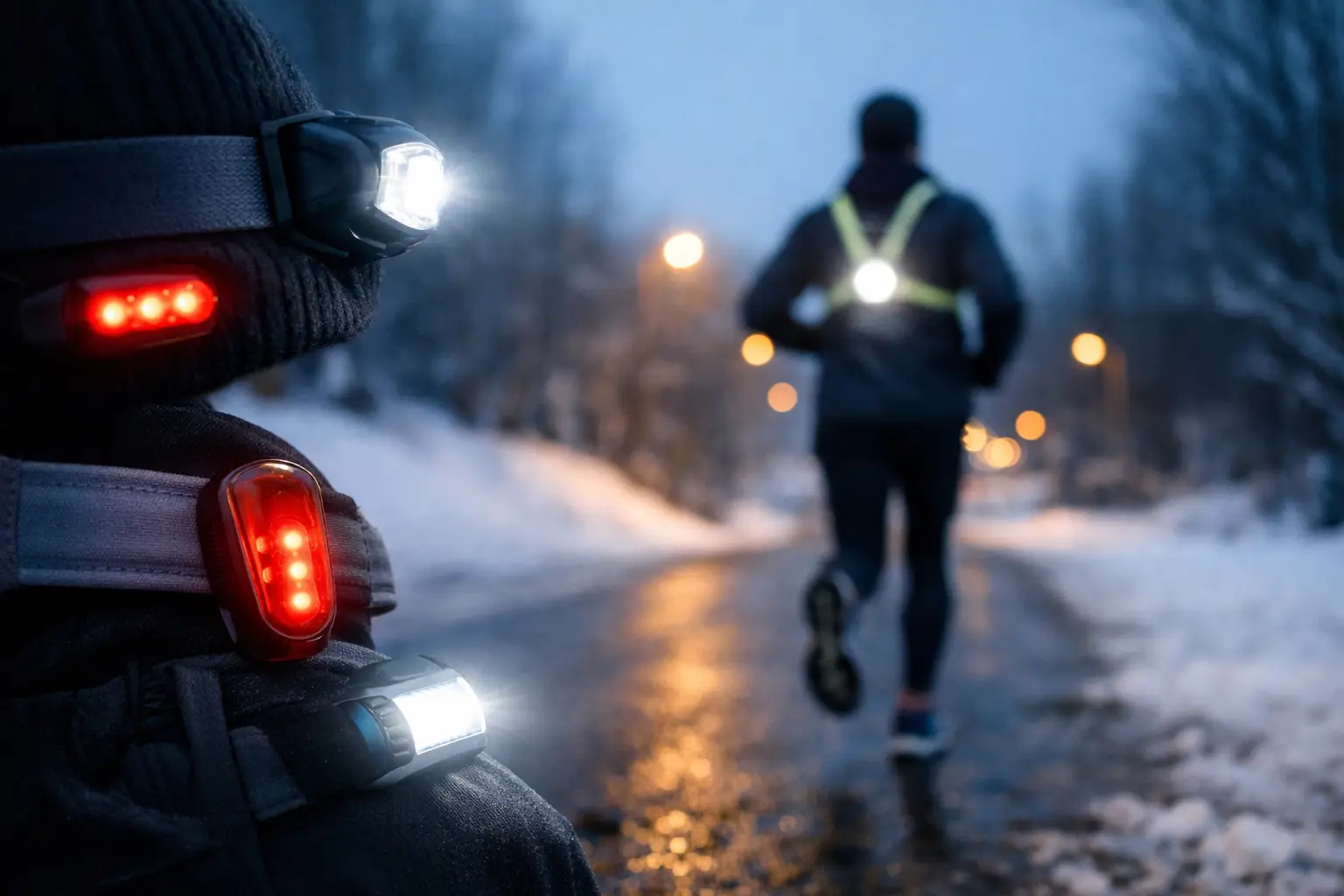
A winter run can begin in daylight and finish under a black sky. Add rain on the road, low sun, spray from passing cars and muddy paths, and being visible becomes more than a nice extra. The best running lights for winter help you see the ground ahead while giving drivers, cyclists and other runners a clear chance to see you.
The right setup is not always the brightest one. It is the one you will actually wear, charge and trust when the weather turns. Choose purposeful gear, look after it, and it can carry you through many dark seasons rather than becoming another disposable purchase.
What the best running lights for winter need to do
Winter running lights have two separate jobs. The first is seeing: spotting kerbs, potholes, puddles, roots and uneven canal paths before your feet find them. The second is being seen: making your movement obvious to anyone sharing the road or path.
A head torch is usually strongest for seeing where you are going. It follows your gaze and gives useful light over changing terrain. A chest light can offer a steadier view of the ground immediately ahead and may feel more balanced for some runners. A rear red light, meanwhile, is about visibility from behind. Reflective straps and clothing add another layer, returning car headlights even if a battery runs flat.
Do not assume one light can cover every situation. A bright white lamp on your chest may help you avoid a slick patch of leaves, but it does little for a driver approaching from behind. For road running, a front light, rear light and reflective detail are a sensible combination. On an unlit trail, put more priority on a dependable forward beam, while keeping reflective elements for shared crossings and roads.
Choose your light by where you run
Lit streets and suburban routes
If your route has regular street lighting, you may not need a powerful beam to navigate. Your main requirement is to stand out against shop fronts, parked cars and wet tarmac. A flashing or pulsing front light, red rear light and reflective vest straps create movement and contrast that are easier to notice than a small reflective logo alone.
Keep the front light aimed down slightly rather than directly at the faces of oncoming pedestrians or drivers. The goal is visibility, not glare. A lower setting is often enough, and it protects battery life for the final miles when you need it most.
Country lanes and unlit roads
Unlit lanes demand more light and more care. Potholes can fill with water, road edges disappear, and car headlights can temporarily reduce what you can see. Look for a light with a focused centre beam for distance plus enough side spill to show the verge and road surface around your feet.
Here, placement matters. A head torch lets you check bends and look towards approaching traffic, but a chest-mounted light can make the next few metres of road easier to read because it throws shadows from a lower angle. If you run these routes often, using both is a practical safety choice rather than overkill.
Trails, parks and towpaths
For technical ground, a stable head torch is often the better starting point. You need to scan ahead for roots, branches and changes in surface, not just light a narrow patch at your shoes. Choose a secure, adjustable strap that does not bounce once you pick up pace.
A very high output setting is not automatically better in fog, drizzle or heavy rain. Strong light can bounce back from moisture and create a bright haze. Use the lowest setting that lets you read the terrain confidently, then increase it for unfamiliar descents, muddy sections or rougher ground.
Look beyond lumen numbers
Lumens are useful, but they are only one part of a good winter running light. A high number can sound impressive while telling you little about beam shape, fit or run time. Think about how you run rather than shopping for the biggest figure on the box.
For city pavements with ambient light, a modest forward light may be plenty. For dark trails or country roads, you will want a brighter, more controlled beam. More importantly, check the stated run time at the setting you plan to use. Some lights last for hours only on their lowest mode, not at full brightness.
A few practical features make a meaningful difference through winter:
- A weather-resistant housing that can cope with rain and road spray.
- A rechargeable battery with a clear charge indicator.
- Several brightness settings, including a low mode for lit streets.
- A lock function that prevents the light switching on inside a running bag.
- An easy-to-operate button that works with cold fingers or gloves.
Do not overlook battery performance in low temperatures. Cold weather can reduce how long a charge lasts, especially on older batteries. For a long run, start fully charged, carry a small backup light where practical, and avoid leaving your light in a freezing car overnight.
Fit is a safety feature
The best light is no help if it bounces, slips or irritates you until you stop using it. Test the fit at an easy jog before relying on it for a dark session. A head torch should sit firmly enough not to bob with each footstrike, without creating pressure across your forehead. A chest light should stay centred and clear of your natural arm swing.
Consider what you wear in winter, too. Thick jackets, gloves and layers can change how straps sit. A reflective vest strap is especially useful because it can be adjusted over a base layer in mild weather or a waterproof shell when conditions worsen. Look for simple adjusters you can use without taking off gloves.
If you carry a running vest, make sure lights and straps do not compete for the same space. Chest straps can catch on bottle flasks, while a rear light may be hidden by a pack. Run a short test loop in your complete kit, not just your usual T-shirt, before heading out on a longer route.
Build a visible winter running setup
Visibility works best in layers. Light catches attention, while reflective material shines back under another vehicle’s headlights. Bright colours can help in daylight, but they are not a replacement for active lighting once darkness falls.
For most road runners, a simple setup is enough: white light at the front, red light at the rear, reflective straps or panels around the torso, and a forward beam if the route is poorly lit. Position lights where they are least likely to be covered by outer layers, your hands or a running pack.
Flashing modes can help a runner stand out in busy urban areas, but a steady beam is often more useful for seeing the surface. There is no single rule for every route. Use a combination when you can, and be considerate around others. Point lights down on shared paths and switch to a lower setting when passing people face to face.
Make your lights last beyond one winter
Choosing durable, rechargeable gear reduces the stream of cheap batteries and short-lived accessories that winter can encourage. Recharge after damp runs only when the charging port is dry, wipe away grit, and let the light air dry before storing it. Check straps for wear and clean reflective material gently so road film does not dull its shine.
Create a small pre-run habit: charge, fit, switch on, check the rear light, then go. It takes less than a minute and avoids the frustrating moment when a dark evening run becomes a phone-torch shuffle home.
4R believes practical running gear should earn its place in your kit. A rechargeable headlight, LED chest light and adjustable reflective straps can support different routes and conditions without filling a drawer with single-purpose clutter.
Winter does not need to shrink your running world. Set your lights up properly, make yourself easy to spot, and let the darker months become a reason to run with more confidence, not less.