

Blog
Guide to Night Running Visibility That Works

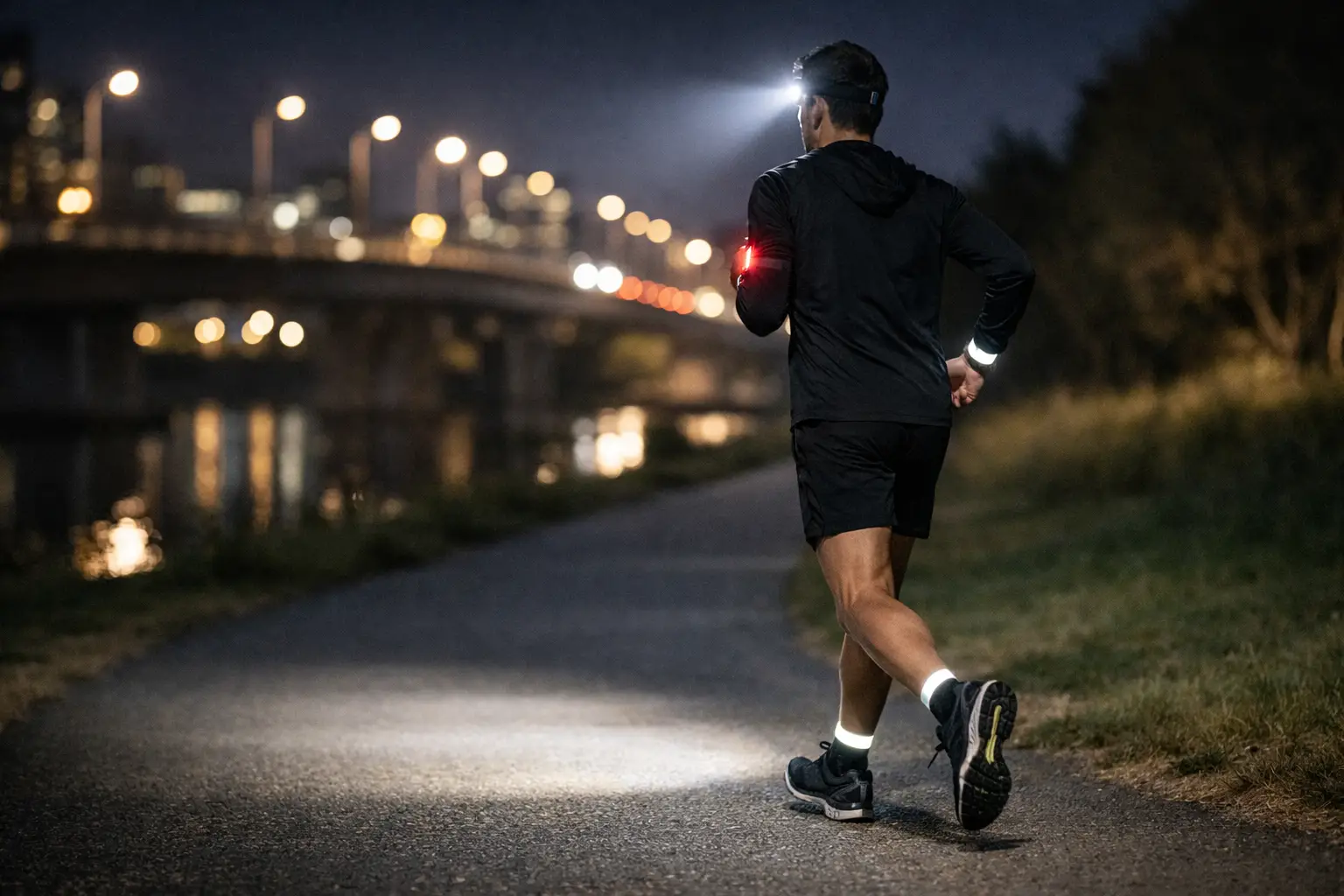
The first dark evening run of the season can feel brilliant – cool air, quieter pavements and no pressure to beat the heat. It can also make you practically invisible to a driver pulling out of a side road. This guide to night running visibility is about fixing that without turning every run into an expensive gear haul.
The goal is not to light up like a Christmas tree. It is to give people enough time to see you, understand that you are moving, and react safely. A few well-chosen, reliable pieces of kit, combined with sensible route choices, make a far bigger difference than a drawer full of disposable accessories.
Guide to night running visibility: start with being seen
Visibility has two jobs. The first is helping you see the surface ahead: kerbs, potholes, uneven paths and the edge of the pavement. The second is helping other people see you from a useful distance. They are related, but they are not the same thing.
A headlight or chest light helps you pick a safe line and makes runners more visible from the front. Reflective material shines brightly when vehicle headlights hit it, but is far less noticeable to someone without a light pointed your way. LEDs create their own light, which makes them useful around cyclists, at road crossings and on poorly lit paths.
For most urban runs, the strongest approach is a combination: a light that faces forward, reflective detail around your body, and one visible light point from behind. That is enough to cover the angles that matter without adding unnecessary clutter.
Light the route, not just your shoes
If your route includes unlit pavement, canal paths, parks or country lanes, use a rechargeable headlight or chest light with a focused forward beam. You need to spot changes in the ground several strides ahead, not only the patch directly beneath your feet.
Brightness matters, but beam direction matters just as much. Angle the light slightly downwards so it reveals the ground without dazzling oncoming runners, walkers or drivers. A light that bounces wildly with every step is frustrating and makes hazards harder to judge. Test the fit before a long run and tighten it enough to stay secure without creating pressure points.
A headlight follows your gaze, which is useful when checking junctions or looking round a bend. A chest light tends to give a steadier view of the path and can make your moving body easier to recognise. Neither is automatically better. Choose based on where you run, the fit you prefer and whether you often wear a hat or headband in colder weather.
Do not assume a bright street means you can leave your own light at home. Pools of street lighting create sharp contrast, and drivers can lose sight of a runner as they pass from a lit area into shadow. Your own light gives you a margin when the road conditions change.
Use reflective gear where movement is obvious
Reflective strips on a jacket are useful, but reflective vest straps often do more because they outline the torso and move with you. A recognisable human shape is easier to process quickly than one small reflective logo.
Place reflectivity low as well as high. Ankle straps, reflective socks or details around your lower legs make use of the running motion that catches attention. If you are crossing a road, that movement can be more noticeable than a static patch on your chest.
A reflective vest is especially practical because it works over the clothing you already own. That supports a more considered running wardrobe: one durable, adaptable layer can serve a dark commute, a winter training run and a weekend event instead of requiring separate outfits for each. Buy gear that earns its place repeatedly.
Build visibility for the route you actually run
There is no single night-running setup for every runner. A well-lit city pavement, a rural road without a footway and a wooded trail demand different choices. Think about traffic speed, lighting, surfaces and how easy it is for someone else to predict where you will be.
On busy town roads, prioritise 360-degree visibility. Wear reflective straps or a vest, use a forward-facing light, and add a rear red LED where possible. Keep your route predictable. Cross at places where drivers expect pedestrians, and avoid stepping between parked cars where your view and theirs are both restricted.
On country lanes, assume that a driver may not expect you at all. A high-visibility outer layer helps in twilight, while reflective elements and active lights take over in full darkness. Run facing oncoming traffic where it is safe and legal to do so, giving yourself the best chance to see approaching vehicles. Stay alert for narrow sections, blind bends and splashing from wet roads.
On trails, your main concern may be footing rather than traffic, but visibility still matters. Other runners, dog walkers and cyclists need to see you. Use a dependable light, slow down when the terrain is unfamiliar, and avoid headphones that remove your awareness of footsteps, bikes or wildlife nearby.
Make your lights part of your pre-run routine
The most effective safety gear is the gear you actually have with you. Recharge lights after use or set a regular charging night each week. Check the battery before heading out, especially when temperatures drop, as cold weather can reduce battery performance.
Give lights a quick inspection. Wipe mud and road spray from the lens, check that straps are not stretched or cracked, and confirm the charging port cover is closed if rain is expected. If a light has multiple modes, learn them at home. You do not want to cycle through flashing patterns at a dark junction while wearing gloves.
Flashing lights can be highly attention-grabbing, but constant mode can be easier for others to judge at close range. A mixed setup often works well: a steady forward beam for the path and a flashing rear light to catch attention. Use the setting that suits the environment, rather than assuming the most aggressive flash is always safest.
Carry a back-up plan on longer runs. That could be a small secondary light, a fully charged phone, or a route that keeps you close to lit streets. It is not about fearing the dark. It is about respecting the fact that batteries, weather and plans do not always cooperate.
Avoid the visibility mistakes that catch runners out
Black leggings and a black jacket may be comfortable and versatile in daylight, but they disappear against wet tarmac at night. You do not need to replace an entire running wardrobe. Add a reflective layer over what you already wear and use lights that can move from jacket to vest as the seasons change.
Another common mistake is relying on one small light. A clip-on LED is useful, but it can be covered by a swinging arm, a hydration pack or a jacket hem. Check your setup in a mirror or ask someone to view you from the front, side and back. Can they immediately tell you are there?
Avoid wearing reflective gear only on your front. You may spend much of a road run moving away from traffic at a junction, on a curved road or when a vehicle approaches from behind. Think in all directions.
Finally, do not let bright kit create false confidence. Visibility gives other road users more opportunity to react, but it does not guarantee they have seen you. Make eye contact where possible, pause rather than gamble at unclear crossings, and give cars more time and space on wet or dark roads.
Choose durable gear, then look after it
Night-running essentials should not be treated as seasonal throwaways. Look for rechargeable lights, replaceable or long-lasting straps, secure clips and weather-resistant construction. A product that works through several winters is better value than a cheap light that fails halfway through a wet November run.
Wash reflective clothing as directed and avoid harsh treatment that can wear down reflective finishes. Store lights somewhere dry, not loose at the bottom of a kit bag where switches can be knocked on and batteries drained. Small habits extend the life of useful gear and reduce the cycle of buying, binning and replacing.
At 4R, the principle is simple: dependable running kit should support your goals without asking the planet to pay the price. Choose fewer pieces, choose them well, and use them hard.
Darkness does not have to shrink your running routine. Set out visible, stay aware, and let the quieter miles do what they do best: remind you that you are capable of more than the weather, the clock or the season suggests.