

Blog
Reflective Vest Straps vs Chest Light

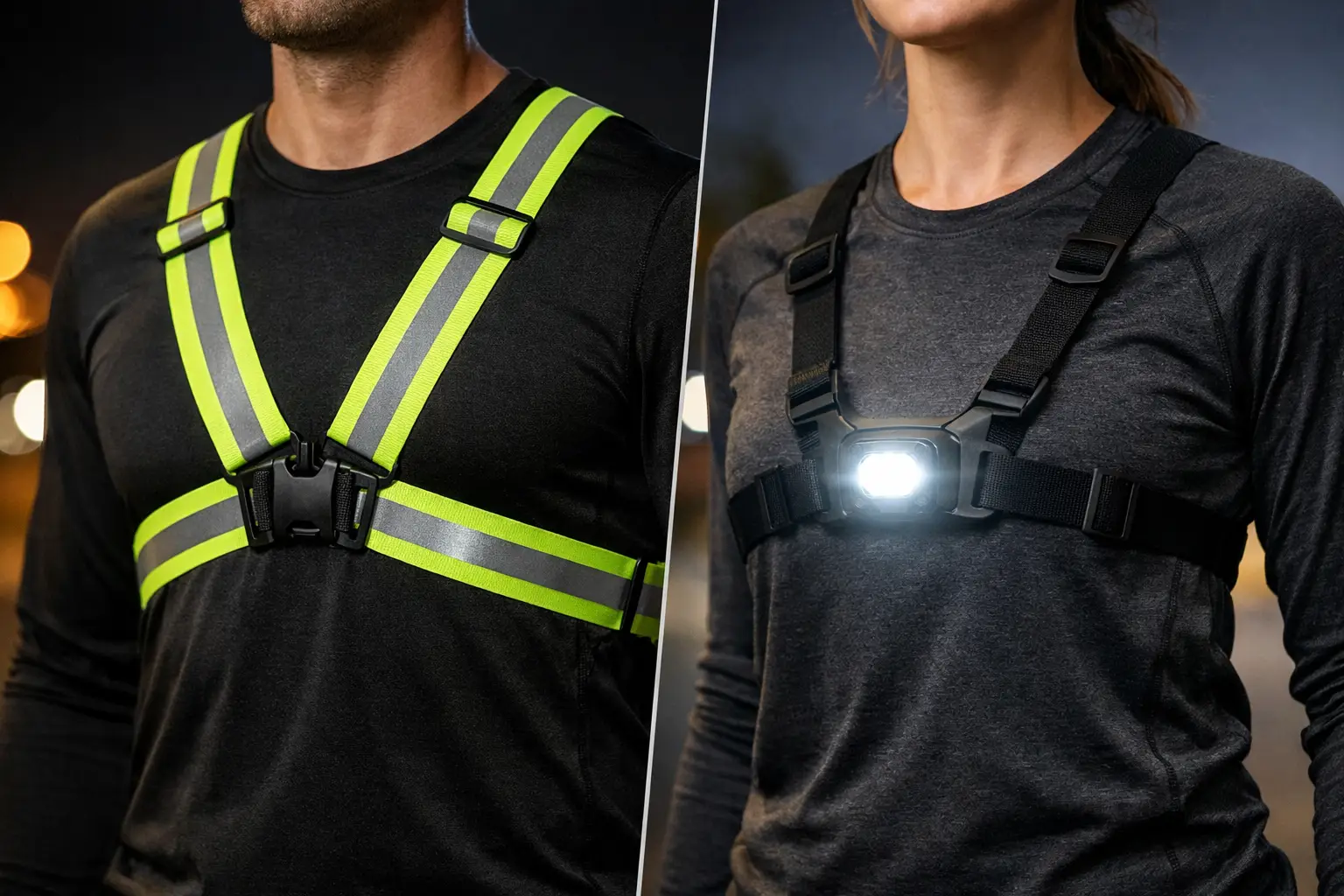
You feel it as soon as the clocks change – your easy evening run suddenly starts in daylight and finishes in gloom. That is where reflective vest straps vs chest light becomes a real decision, not a gear debate for the sake of it. If you run before sunrise, after work, or through dull winter mornings, the right visibility setup can make you feel calmer, safer and more focused from the first kilometre.
Reflective vest straps vs chest light: what is the difference?
At a basic level, reflective vest straps help other people see you. A chest light helps you see where you are going and, depending on the design, helps others see you too. They solve related problems, but not exactly the same one.
Reflective vest straps usually sit lightly over your top or jacket and use reflective material, sometimes with added LED elements, to make your body outline more obvious in headlights and street lighting. They are simple, low-fuss and often the first thing runners buy when darker miles become part of the week.
A chest light is more active. It throws light forward onto the road, path or trail, giving you a better view of kerbs, puddles, uneven surfaces and corners. Many also include rear lighting or reflective detailing, but their main strength is illumination rather than passive visibility.
That difference matters because being seen and seeing clearly are not interchangeable. If your route is well lit, reflective straps may be enough. If your route is darker or more technical, a chest light can make a bigger difference to your confidence and footing.
When reflective vest straps make more sense
Reflective vest straps are often the smarter choice for urban runners. If you mostly run on roads with street lamps, along pavements, or through neighbourhoods where drivers already have decent visibility, the priority is usually making your movement and position obvious from a distance.
That is where straps work well. They are light, compact and easy to pull on over a T-shirt, base layer or waterproof. They also tend to feel less intrusive than a lamp unit on your chest, especially if you like your kit minimal and hate carrying extra weight.
They can also be the more versatile option if you do more than run. Walk the dog, cycle to the gym, head out for an early morning bootcamp – reflective straps can cover all of it. For runners trying to buy fewer, better things, that kind of cross-use matters.
Another plus is recharge-free simplicity if you choose a non-powered version. No battery anxiety, no forgetting to top it up before an early alarm, no discovering at the front door that your light is dead. Sometimes practical wins.
Still, reflective straps have a limit. They rely heavily on external light sources. On a quiet lane, canal path or poorly lit park route, they do not help you spot the branch, pothole or patch of slick leaves ahead.
When a chest light is the better tool
If your runs regularly take you into darkness rather than just low light, a chest light starts to justify itself quickly. It does a job reflective gear cannot do – it lights your route in real time.
That means better footing on uneven ground, faster reactions to obstacles and less guesswork when conditions are poor. If you run on mixed terrain, winter paths, country roads or unlit cycleways, that extra visibility can reduce stress as much as it reduces risk.
Chest lights also tend to feel more stable for many runners than head torches. Because the beam comes from your torso, the light follows your body line rather than every glance to the side. Some runners prefer that smoother, lower-angle illumination, especially when scanning the ground ahead.
There is also a comfort point here. A chest-mounted light avoids pressure on the forehead and can feel less distracting than wearing something around your head for an hour. If hats, sweat and bouncing torches annoy you, chest lighting can be a cleaner solution.
The trade-off is obvious. It is another device to charge, another item to remember, and sometimes another strap system layered over winter kit. If the fit is poor, it can bounce. If the beam is too bright or badly angled, it can feel excessive on a lit route.
Comfort, fit and how they affect your run
Runners do not keep using gear just because it is useful. They keep using gear that disappears once the run starts.
Reflective vest straps usually score well here. They are often lighter, lower profile and less noticeable over time. For short weekday miles, that can be enough to make them the default option. They are also easy to adjust when your layers change between autumn drizzle and cold winter mornings.
Chest lights ask a bit more from fit. A good one should sit close to the body without squeezing your breathing or rubbing over a base layer. If it shifts with every stride, you will know about it quickly. For runners with a regular, steady arm drive, stable chest-mounted systems can feel excellent. For others, especially if the unit is bulky, comfort can drop off on longer runs.
This is why there is no universal winner in reflective vest straps vs chest light. The best option is often the one you will genuinely wear every time, not the one with the longest feature list.
Think about your route, not just the product
A lot of buying mistakes happen because people shop for the most advanced option instead of the right one.
If your normal run is twenty-five minutes around lit streets before work, reflective vest straps may be exactly what you need. They improve visibility, take seconds to put on and do not complicate your routine. If your route includes dark sections but most of it is still urban, straps with added LED visibility can be a sensible middle ground.
If you are heading onto darker roads, towpaths, park loops or winter trails, a chest light starts to look less like an upgrade and more like basic kit. The poorer the ambient light, the stronger the case becomes.
Weather also changes the equation. In rain, mist and fog, road users may struggle to pick you out early enough. Reflective materials can still work well in headlights, but active light can cut through murky conditions more effectively. On the other hand, in heavy rain, some runners prefer the lighter, simpler feel of reflective straps and save chest lights for truly dark sessions.
Is one safer than the other?
That depends on what kind of risk you are trying to reduce.
Reflective vest straps are strong on visibility to others, especially around traffic. They help define the human shape, which can make drivers recognise you faster than a small light alone. If your main concern is cars pulling out at junctions or passing on narrow roads, that matters.
Chest lights are strong on environmental awareness. They help you avoid hazards, hold your line and stay more relaxed on dark ground. If your main concern is not seeing what is underfoot, they win that argument.
For many runners, the safest answer is not one or the other. It is matching the tool to the route, or combining both when conditions are at their worst. That is not overkill if it means you run with confidence instead of hesitation.
What about sustainability and buying fewer, better products?
This is where the choice gets more personal. A cheap piece of visibility kit that fails after one season is not a bargain. It is just waste with a low price tag.
Reflective vest straps can be a strong low-consumption option because they are simple and often durable. Fewer components usually mean fewer failure points. If you want one piece of gear you can keep by the door and use across running, walking and commuting, they make sense.
A rechargeable chest light can also be a responsible choice if you actually need the function and use it regularly. Buying one dependable light that lasts through several winters is far better than cycling through flimsy disposable gear that lets you down when you need it most.
That is the bigger point. Good kit should earn its place. At 4R, that idea matters because runners should not have to choose between performance, reliability and responsible buying.
So, which should you choose?
Choose reflective vest straps if you mainly run in built-up areas, want maximum simplicity, and need to be more visible without adding much bulk. Choose a chest light if your routes are genuinely dark, uneven or unpredictable, and you want to see the ground clearly rather than just be seen.
If your training changes with the season, your answer may change too. Plenty of runners use reflective straps for weekday road miles and keep a chest light for darker long runs or rural routes. That is not indecision. It is using the right gear for the right job.
The smartest running kit does not look impressive sitting on a shelf. It quietly solves a problem, lasts well and helps you get out the door when conditions are less than ideal. Pick the option that makes your next dark run feel simpler, safer and easier to say yes to.