

Uncategorized
Best No Tie Laces for Running
Mar
A lace coming undone at mile three is annoying. A lace coming undone on a wet corner, during a race start, or halfway through a dark winter run is worse. That is why more runners are swapping standard laces for elastic options that stay put, save time and make shoes easier to get on and off.
The best no tie laces for running are not always the most expensive or the most complicated. For most runners, the right pair is the one that gives a secure fit without pressure on the top of the foot, stays locked through repeated runs, and does not need fiddling every time you head out. If you run regularly, that small upgrade can make daily training feel simpler.
What makes the best no tie laces for running?
A good pair of no-tie laces should do three jobs well. First, they need to hold your foot securely enough that your shoe does not feel loose on corners, descents or faster efforts. Second, they should stretch enough to reduce pressure points. Third, they need a fastening system that does not slip once set.
That balance matters because running puts different demands on laces than walking or casual wear. A lace setup that feels fine on a short trip to the shops can feel unstable on a 10K. Too much stretch and your foot can move around inside the shoe. Too little and you lose the comfort benefit that made elastic laces appealing in the first place.
For most everyday runners, the sweet spot is moderate elasticity with a simple locking toggle or clip. It should be easy to adjust, but once tightened, it should stay there.
Why runners switch to no-tie laces
Convenience is the obvious reason, but it is not the only one. Elastic laces can create a more even hold across the foot than traditional laces, especially if you often overtighten certain eyelets to stop heel slip. That more forgiving fit can help if your feet swell slightly on longer runs or if you find normal laces leave pressure marks.
They also make transitions easier. That is useful for race mornings, quick lunchtime runs, or anyone who does not want to spend extra time retying shoes with cold hands. If you are training before work or heading out in poor weather, simple kit choices matter.
There is also a durability angle. Standard laces can fray, absorb water and loosen over time. Well-made elastic laces tend to handle repeat use better, though this depends on the quality of the cord and the lock.
The main types of no-tie running laces
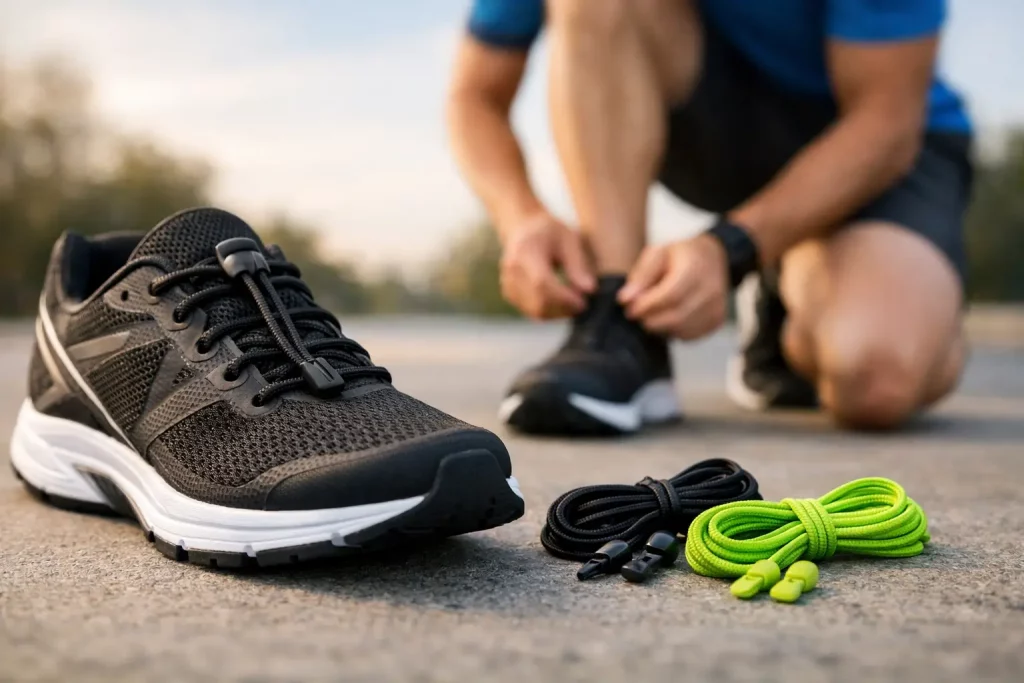
Not all no-tie laces feel the same once fitted. The most common type uses an elastic cord with a spring-loaded toggle. This is popular for running because it is quick to adjust and easy to replace. If the tension feels wrong after your first run, you can fine-tune it in seconds.
The second type uses elastic segments or fixed anchors across each eyelet. These can feel neat and low-profile, but they usually offer less flexibility once installed. They suit runners who already know exactly how they like their shoes to fit.
The third option is a simple stretch lace with a clip lock at the end. This sits somewhere in the middle. It is tidy, practical and often the easiest style for general training.
For most people looking for the best no tie laces for running, adjustable elastic cord systems are the safest choice. They are forgiving, simple to set up and suitable for everything from easy miles to race day.
How to choose the right pair for your running
Start with fit, not branding. Your shoe already has its own shape, upper tension and lockdown feel, so the lace should work with that rather than fight it. Softer daily trainers usually pair well with standard elastic no-tie laces because they are built for comfort anyway. More structured shoes, especially those used for sessions or racing, may need a firmer elastic lace so the foot still feels locked in.
If you often get numbness across the top of your foot, look for softer stretch and smoother tension. If your usual problem is heel movement, choose a lace with a more secure lock and less bounce. Neither is better in every case. It depends on your shoe and how you run.
Length matters too. Some lace kits are meant to be cut to size after fitting. That gives a cleaner result, but only if you are confident setting them up. If you are not, a pre-sized option can be easier.
The lock itself is worth paying attention to. A cheap lock that slips ruins the whole point. The best ones stay secure but can still be adjusted without a struggle. A bulky lock can also create discomfort if it sits awkwardly on top of the shoe, so lower-profile designs usually work better for regular running.
Comfort versus lockdown
This is the trade-off that matters most.
If you run easy miles, commute on foot, or want one pair of shoes for both running and everyday wear, a softer no-tie setup often feels best. It reduces hot spots and makes shoes easier to slip on. For general training, that is enough.
If you run faster sessions, race regularly, or take on hilly routes with lots of direction changes, you may prefer a firmer setup. You do not want your foot shifting inside the shoe when you are pushing the pace. In that case, a no-tie lace can still work well, but it needs to be adjusted more carefully.
Some runners find elastic laces are perfect in daily trainers but not ideal in carbon race shoes or narrow performance models. That is not a flaw. It just means the best choice depends on the job the shoe is doing.
Are no-tie laces good for racing?
Often, yes. They are especially useful in triathlon, parkrun, road races and any event where quick transitions and low fuss matter. Once set correctly, they remove the risk of a lace loosening mid-race. That peace of mind is worth a lot.
But race fit needs testing in advance. Do not install a new pair the night before an event and assume they will be fine. Run in them a few times first. Check whether the forefoot feels too tight after a few miles, whether the heel stays secure, and whether the lock remains in place.
For shorter races, some runners like a slightly firmer setting. For longer distances, a touch more give can be better as feet expand. Again, it depends.
Common mistakes when fitting no-tie laces
The biggest mistake is overtightening them at the start. Because elastic gives under pressure, runners sometimes pull harder than they would with regular laces. That can leave the shoe feeling fine while standing still, then uncomfortable once running.
The second mistake is setting equal tension across every eyelet. Most feet do not need that. You may want a little more room over the forefoot and a more secure feel nearer the ankle. Good no-tie laces let you create that balance.
The third mistake is trimming too early. If your lace system needs cutting, leave extra length until you have done at least two or three runs. It is easier to shorten later than fix a lace that has been cut too aggressively.
A practical pick for everyday runners
If you want a straightforward option that covers the basics well, elastic lock laces designed specifically for training are usually the best place to start. Look for a pair with durable stretch cord, a secure low-profile lock and enough adjustability for different shoe types. That is the kind of upgrade that suits most runners without adding cost or complication.
At 4R, the focus is on practical running accessories that solve everyday problems, and that approach makes sense here. No-tie laces do not need hype. They just need to be comfortable, reliable and affordable enough that they feel like an obvious improvement.
When no-tie laces may not be the best option
They are not for everyone. If you are very particular about micro-adjustments before each run, traditional laces still give the most precise control. If your shoes already fit loosely in the midfoot, switching to very soft elastic laces can make that worse. And if you rotate between thick winter socks and thin race socks in the same pair of shoes, you may need to readjust more often than expected.
That said, many runners find those drawbacks are minor compared with the convenience. Once you have a pair dialled in properly, they are one less thing to think about.
A small gear change will not transform your running, but it can remove one regular irritation. If your laces keep coming loose, your shoes feel awkward to get on, or you want a cleaner, simpler fit, no-tie laces are well worth trying.
