
Uncategorized
What Lights Do Runners Actually Need?
Mar
If you’ve ever stepped out for a winter run and realised five minutes in that you can barely see the kerb, you already know the answer is not “whatever torch is lying in the drawer”. The right running light makes the difference between a confident run and one spent dodging puddles, uneven pavements and traffic.
For most runners, the real question is not whether you need lights. It is what lights do runners need for the routes, times and conditions they actually run in. That depends on whether you need to be seen, need to see, or need both.
What lights do runners need for safe running?
Most runners need two things in low light. First, something bright enough to help them see the ground ahead. Second, something visible enough to help other people spot them early.
Those are not always the same product. A reflective vest helps others see you when light hits it, but it does not light your path. A headlight helps you see where you are going, but if it is pointed down a dark canal path it may not do much for visibility from the side or behind. That is why many runners are best served by combining active lighting with reflective gear.
If you run on lit streets at dawn or dusk, a compact chest light or headlight plus reflective details is usually enough. If you run on darker roads, country lanes, trails or poorly lit parks, you will need stronger forward lighting and better all-round visibility.
Seeing vs being seen
This is the simplest way to choose the right setup.
If your route is dark and uneven, your priority is seeing. You need enough beam strength to pick out changes in surface, puddles, potholes, roots or kerbs in time to react naturally. That usually means a proper running headlight or chest light rather than relying on street lighting.
If your route is mainly urban and already lit, your priority may be being seen. Drivers, cyclists and other pavement users need to notice you quickly and judge where you are moving. In that case, reflective gear and a lighter output lamp can work well.
For a lot of runners, especially in autumn and winter, the safest answer is both. It is a small gear upgrade that makes regular training easier.
Headlights, chest lights and clip-on lights
Running headlights
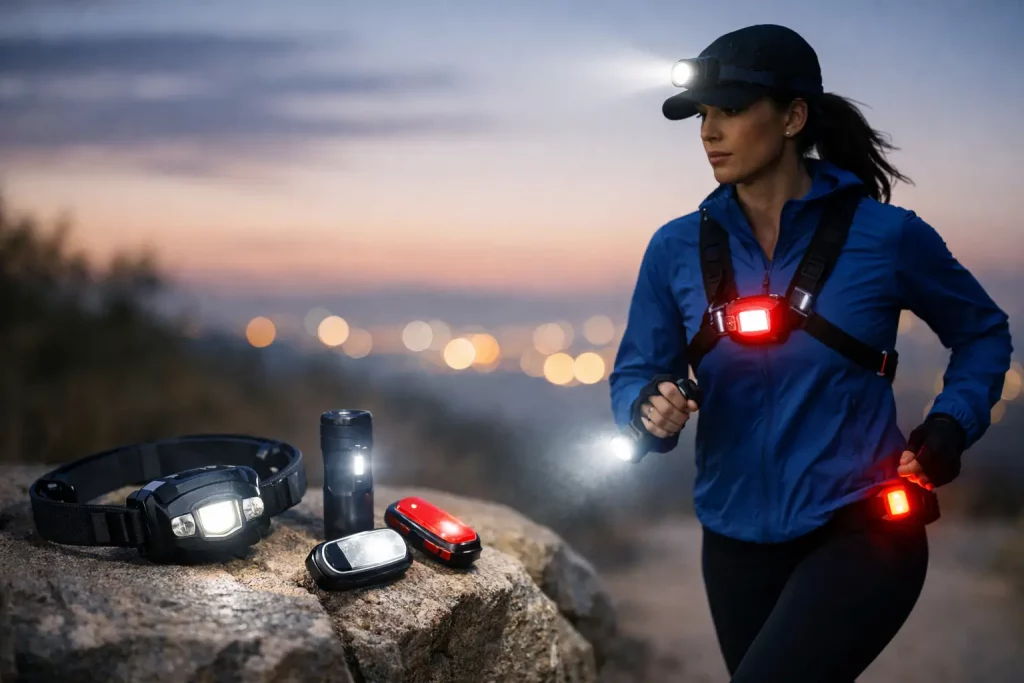
A running headlight is often the most useful all-round choice. It points where you look, leaves your hands free and works well on roads, pavements and trails. If you run before work, head out after dark or travel between lit and unlit sections, a rechargeable headlight is practical and easy to keep by the door.
The trade-off is movement. Because the light sits on your head, the beam moves every time you glance sideways. Some runners do not mind that at all. Others find it distracting, especially on longer runs. Fit matters too. If the strap slips or bounces, the run becomes annoying very quickly.
Chest lights
Chest lights sit lower on the body and often feel more stable. The beam stays closer to the ground, which can make it easier to read the surface ahead without the jitter you sometimes get from a head-mounted light. Many runners also find chest lights more comfortable than wearing something around the forehead.
The downside is that chest lights do not follow your gaze. If you turn your head to check a junction, the beam stays facing forward. For road runners and commuters this is often fine. For technical trails, some still prefer a headlight.
Clip-on and small safety lights
Clip-on lights, flashing lights and wearable visibility lights are useful add-ons, not usually your main light source. They help create presence from the side or rear, which matters if you are running near traffic or crossing roads in poor light.
These are especially handy when your front light does a good job of helping you see, but you still want better visibility from angles your main beam does not cover.
How bright should a running light be?
More brightness is not always better. It needs to match the route.
For well-lit pavements and urban streets, a lower to mid-level output can be enough. You are topping up existing visibility rather than creating all of it yourself. Too much brightness in a built-up area can feel harsh, and it may be uncomfortable for people coming towards you.
For darker roads, canal paths, parks and trails, you need a stronger beam with enough spread to show what is underfoot and what is coming next. If your light has multiple settings, that is ideal. You can use a lower mode in brighter sections and save a higher mode for genuinely dark stretches.
Battery life matters just as much as headline brightness. A very bright light is no bargain if it only lasts for part of your run or drops output quickly in cold weather. Most everyday runners are better off with a reliable rechargeable light that balances brightness, runtime and comfort.
What lights do runners need in different conditions?
For street running
If you mostly run in towns or suburbs with street lamps, a lightweight headlight or chest light plus reflective gear is usually enough. You are not trying to flood the road with light. You are making sure you can see changes in the pavement and be seen clearly at junctions and crossings.
For country roads
Country roads are where visibility becomes more serious. There may be no pavement, little ambient light and drivers approaching at speed. Here, runners should think about front lighting and visibility from several angles. A chest light or headlight, combined with reflective high-visibility gear, is a sensible setup.
For trails and parks
Trail running in low light usually needs the strongest setup of all. Roots, mud, stones and changes in level appear quickly. You need a beam that gives you enough warning to place your feet properly. Many runners prefer a headlight here because it follows their line of sight, though some like pairing it with a chest light for better depth on the ground.
For commuting runs
If you run to work or fit training around a busy day, convenience matters. Rechargeable lights that are easy to put on, remove and top up are the best option. If a light is fiddly, you are less likely to use it consistently.
Reflective gear still matters
A common mistake is thinking a bright lamp replaces reflective clothing. It does not.
Active lights produce their own illumination. Reflective details bounce light back when headlights hit them. Together they do a better job than either one alone. Reflective gear also helps in situations where your main beam is not facing the person who needs to notice you.
That is why many runners use a simple combination: a rechargeable headlight or chest light to see ahead, and reflective wear to improve visibility from the front, side and rear. It is practical, not overcomplicated, and it works.
Features worth paying for
Not every extra feature matters, but a few are genuinely useful.
Rechargeability is high on the list. It saves buying batteries and makes regular use simpler. Adjustable brightness is also worth having because running conditions change. A secure fit matters more than people expect, especially if you run more than a few miles at a time.
Weather resistance is another one to take seriously. British running weather is not always kind, and a light needs to cope with drizzle, spray and cold mornings without fuss. If you are comparing products, comfort and reliability are often better indicators of value than chasing the highest stated brightness.
So, what should most runners buy?
For most everyday runners, the best setup is straightforward: one reliable rechargeable front light and one layer of reflective visibility.
If you prefer the beam to follow your gaze, choose a running headlight. If you want a steadier, lower-positioned beam, choose a chest light. Then add reflective gear so you are visible from more than one angle. That setup covers early starts, evening miles, winter training and commuting runs without making things complicated.
If you only run in well-lit areas, you can keep it simpler. If you run dark lanes or trails, step up the brightness and make sure the battery life suits your longest sessions. The right answer is not the most expensive setup. It is the one you will actually wear every time light is poor.
At 4R, that practical approach is the point. Good running gear should solve a real problem, feel easy to use and not cost more than it needs to.
If your runs regularly start or finish in the dark, treat lighting like any other essential bit of kit. When you can see clearly and others can see you, the whole run feels calmer from the first step.
