
Uncategorized
How to Be Visible When Running
Mar
That near-miss usually happens before sunrise, at a side road, when a driver is watching for cars and not expecting a runner. If you are wondering how to be visible when running, the answer is not one magic item. It is a mix of contrast, light, movement and sensible choices that make you easier to notice from farther away.
For most runners, visibility matters in the ordinary miles. Early starts before work, winter evening sessions, dog walkers on shared paths, cyclists coming round bends, and traffic pulling out of junctions all create moments where being seen early gives everyone more time to react. You do not need expensive kit or a full reflective outfit. You do need to think like the person trying to spot you.
What actually makes runners visible
The first thing to know is that bright and reflective are not the same. Bright clothing helps in daylight and dull weather. Reflective details help when light from a car, bike or street lamp hits them. In full darkness, neither works especially well on its own without some kind of active light.
That is why runners sometimes feel visible while still blending into the road. A fluorescent yellow top can stand out on a grey morning, but on an unlit lane at 6am it is far less effective than a proper running light. On the other hand, a small reflective logo on black kit is better than nothing, but it does not create enough visible movement at a distance.
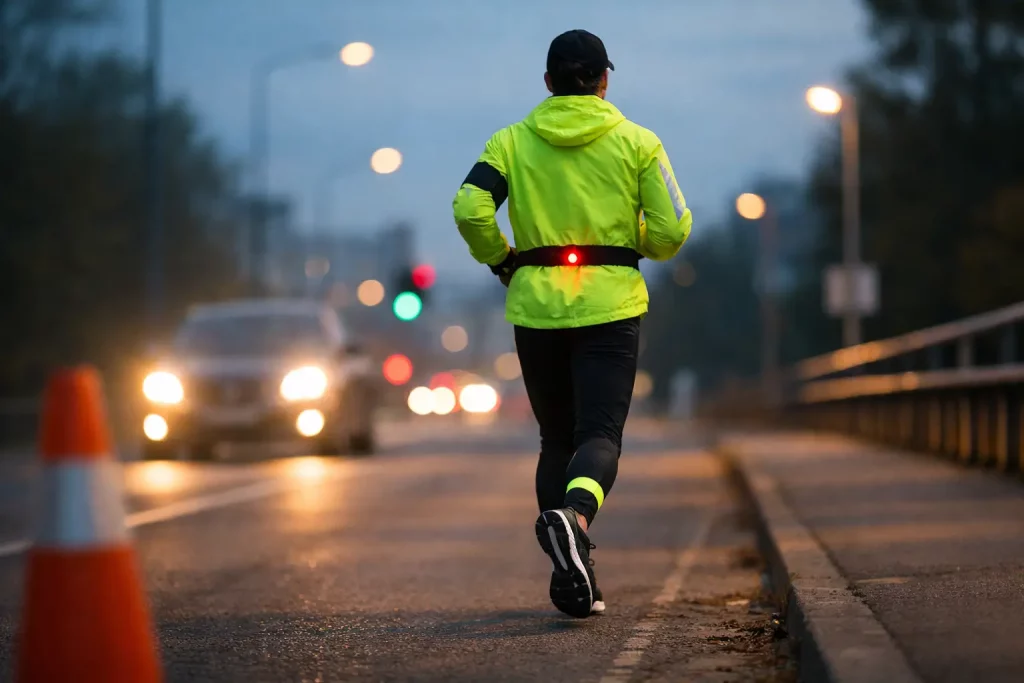
The most effective setup usually combines three things. First, a light source such as a headlight or chest light. Second, reflective gear placed where it moves, like arms, ankles or a gilet panel. Third, colours that do not disappear into the background in low light, rain or fog.
How to be visible when running in different conditions
A common mistake is wearing the same setup all year. Visibility needs change with the season, your route and the time of day.
Early morning and evening runs
These are the highest-risk times for many runners because roads are busy and natural light is poor. A rechargeable running headlight or chest light is usually the best starting point because it helps others see you and helps you see the surface ahead. That matters on pavements with broken edges, puddles, kerbs and uneven paths.
A chest light can feel more stable for some runners, especially on darker lanes or canal paths where depth perception matters. A headlight follows your line of sight, which can be useful when you need to look ahead into corners or across crossings. Neither is automatically better. It depends on fit, comfort and where you run.
Daylight, rain and overcast weather
You can be hard to spot even in daytime when the sky is flat and everything looks grey. In these conditions, high-visibility colours help more than people realise. Reflective strips still add value, but they are not doing the main job. Think about contrast against the background. If you run through parks, greens and yellows can blend in less than dark blues, greys or black.
Rural roads and unlit paths
Here, active lighting matters most. Drivers may approach at speed and dip beams late. You want to be noticed before they are close enough to need a sudden decision. Reflective gear on moving parts, especially ankles and wrists, can help because human movement is easier to recognise than a static patch of light.
If your route includes stretches without pavements, face oncoming traffic where it is safe to do so. That gives you a better chance to react and helps you judge whether a driver has seen you.
The best gear choices are simple, not complicated
There is no need to overload yourself with gadgets. A few dependable items do more than a drawer full of things you forget to wear.
A good light should be easy to charge, quick to put on and comfortable enough that you do not leave it at home. If it bounces, pinches or runs flat halfway through a session, it becomes dead weight. The same goes for reflective accessories. If they are fiddly, runners stop using them.
For most people, the practical combination is a rechargeable running headlight or chest light, plus reflective elements on the torso and lower legs. Lower-leg visibility is often overlooked, but it can be very effective because the motion catches attention. If your shoes already have some reflective detail, that helps, but it rarely replaces dedicated gear.
When choosing clothing, avoid building your low-light setup around black kit. Black leggings and a black jacket may feel neat and versatile, but they work against you in poor light. If you prefer darker clothing, add a high-visibility outer layer rather than relying on tiny reflective logos.
A reflective vest or gilet is one of the easiest upgrades because it goes over what you already own. It is especially useful for runners who head out at mixed times and do not want separate wardrobes for every season.
Fit and comfort matter more than you think
Runners are good at buying safety gear and then quietly not wearing it. Usually the reason is comfort. A light that rubs, a vest that flaps, or straps that shift every kilometre will end up in a drawer.
This is where practical accessories earn their place. Gear should be easy enough to use when you are half awake for a 6am run and reliable enough to forget about once you start moving. Convenience is not a bonus. It is what makes safer habits stick.
If you run in layers, check that your visibility gear still works over bulkier winter clothing. A reflective harness that fits over a thin tee in September may sit badly over a waterproof jacket in January. Test your setup on a short run rather than discovering the problem on a dark ten-miler.
Route choice is part of visibility too
Knowing how to be visible when running is not only about what you wear. It is also about where and how you run.
A well-lit route with predictable crossings is usually safer than a scenic one with blind bends, narrow pavements and long dark sections. If you have a choice, pick streets where drivers expect to see pedestrians and cyclists. Familiarity helps. So does width. A broad pavement beside a main road may be safer than a quiet lane with no verge.
Junctions deserve extra attention. Many drivers are checking for gaps in traffic, not scanning for a runner approaching from the side. Slow slightly, make eye contact where possible, and assume you have not been seen until you are sure. This is especially true in rain, when windscreens, mirrors and low light all reduce visibility.
Shared paths create a different problem. Cyclists and dog walkers may not hear you coming, particularly in winter hats or with headphones. A light facing forward helps, but so does giving people time to notice you and moving predictably around them.
Small habits that make a real difference
Good visibility is mostly routine. Charge lights after use, keep reflective kit by the door, and check the weather before heading out. These are not dramatic changes, but they remove the friction that leads to poor decisions.
It also helps to think about the return leg of your run. Plenty of runners set off in daylight and finish in gloom, especially in autumn and winter. If there is any chance the light will fade, bring the gear. The extra few seconds at the start are worth it.
Another simple habit is checking your setup from a distance. Stand outside, switch on your light and look at your kit in a mirror or ask someone else to take a quick look. What feels obvious up close may disappear at twenty metres.
If you are building a more dependable low-light setup, keep it straightforward. One reliable light, one reflective outer layer and a route you trust will usually do more than a complicated mix of accessories. Brands such as 4R focus on these practical upgrades because they solve everyday running problems without turning a basic training run into a gear project.
Visibility is not just for winter
It is easy to treat this as a cold-weather issue, but poor visibility happens year-round. Summer storms, shaded trails, late evening runs and dark commutes all change how well others can see you. The point is not to dress like a roadworks sign on every run. It is to match your gear to the conditions and make yourself easy to recognise as a person in motion.
That usually means thinking beyond style and asking a simpler question: if a driver, cyclist or pedestrian had three seconds to notice me, would they? If the answer is maybe, add the light, pull on the reflective layer and give yourself the extra margin. Running feels better when safety is one less thing to second-guess.
