
Blog
Headlamp Beam Comparison for Safer Night Runs

A dark run can feel brilliant – quiet roads, cooler air, fewer distractions – until your light leaves you guessing where your next footfall will land. This headlamp beam comparison cuts through lumen hype and focuses on what runners actually need: clear ground, useful distance vision and a beam that stays steady when the pace picks up.
The right headlamp is not necessarily the brightest one. For a runner on a lit pavement, a wide, gentle beam may be the smart choice. For a technical trail runner picking through wet roots and loose stone, reach and beam control matter far more. Buy for the route you run most, not for a number on a product box.
Why beam shape matters more than headline lumens
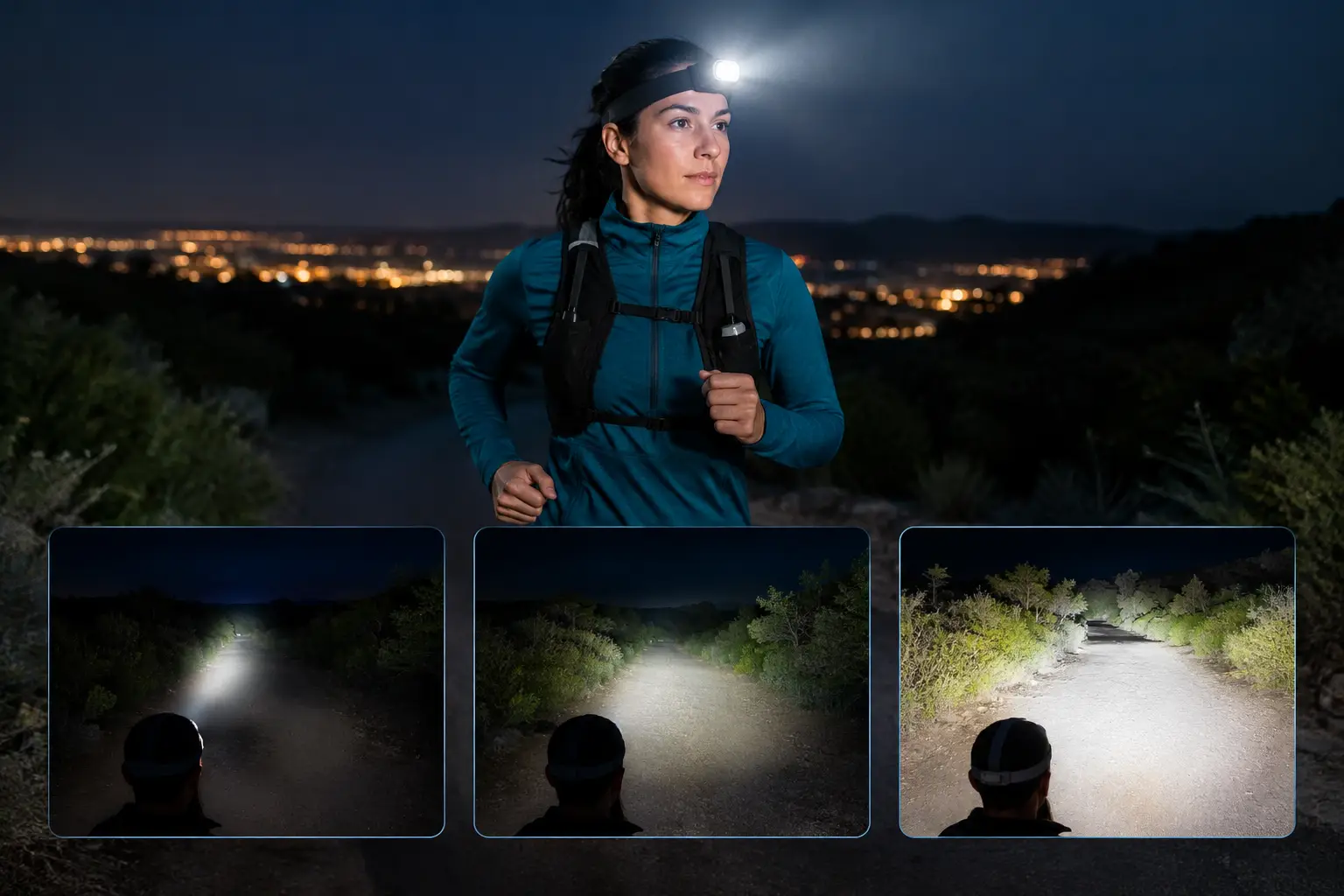
Lumens measure the total amount of light a lamp can produce. They do not tell you where that light goes. A high-lumen headlamp with a narrow beam can make distant markers look sharp while leaving the ground at your feet oddly dark. A lower-lumen flood beam can make a towpath or pavement feel far easier to read.
For running, light needs to do three jobs at once. It should reveal the surface immediately ahead, give you enough warning of obstacles further up the route, and make the edges of your path visible. The last point is easy to overlook until a narrow beam causes a bout of tunnel vision. Your eyes focus on a small bright patch while potholes, kerbs and bends sit outside it.
Brightness also has a cost. More output usually means shorter battery life, greater heat and, on some units, a heavier battery pack. A lamp that begins a run at maximum power but steps down after 30 minutes is less useful than one that provides a reliable medium setting for the full session.
Headlamp beam comparison: flood, spot and mixed beams
Flood beam: the best starting point for roads and easy paths
A flood beam spreads light widely and fairly evenly across the scene. It is the most natural fit for road running, park loops, canal paths and firm tracks where you mainly need to see the surface in front of you. It helps you pick out kerbs, puddles, dog walkers and the uneven edge of a pavement without constantly turning your head.
The comfort factor matters. A broad pool of light reduces the stark contrast between a lit centre and complete darkness around it, so your eyes tend to work less hard. On familiar routes with some street lighting, a modest flood setting is often all you need.
The trade-off is distance. Flood beams can feel weak on unlit open ground because their light is spread across a wider area. If you run fast on dark country lanes or need to identify a trail marker well ahead, flood alone may not give enough warning time.
Spot beam: useful reach, but not always useful running light
A spot beam sends light into a concentrated, long-reaching cone. It is useful for seeing a gate, signpost, bend or marker far ahead. On uneven mountain paths, it can help you plan the line you will take next.
Used on its own, however, a spot beam can be a poor match for running. The sharply focused centre can exaggerate shadows and make close obstacles difficult to judge. You may see the far side of a puddle beautifully while missing the rock at your toes.
A spot setting works best as a supplement. Use it briefly to check the route ahead, then return to a wider setting for steady movement. It can also be helpful on a rural road where you want to scan further ahead for oncoming traffic, but never look directly at drivers with a high-powered beam.
Mixed beam: the most versatile option for changing routes
A mixed beam combines a wide flood with a central spot. For many runners, it is the most practical setup because it covers near-field footing and forward planning at the same time. This is particularly useful for winter training, when a route can move from a lit estate to a dark lane and then onto a muddy trail.
Mixed light is not automatically better. Poorly designed combined beams can create distracting hot spots or drain the battery quickly at full power. Look for independent controls or sensible preset modes, so you can use mostly flood when the terrain is simple and add reach only when it earns its place.
For runners who want one durable piece of kit rather than a drawer full of single-purpose gadgets, this flexibility is worth prioritising. Buy fewer things, choose them carefully and keep them in use for years. That is better for your kit budget and better than feeding the disposable cycle of fast-fashion sports gear.
Match the beam to your running route
Your usual terrain should decide the beam pattern and power setting. A runner doing 5K laps around town has different needs from someone tackling boggy forest tracks before work.
On urban roads and pavements, choose a broad flood beam with a low or medium mode. Streetlights will do part of the work, and too much brightness can reflect off signs, wet tarmac and pale walls. A comfortable, even beam keeps the ground readable while preserving awareness of your surroundings.
On unlit country lanes, mixed output is generally the strongest choice. You need a wide view for road edges and debris, plus enough forward reach to assess bends and spot people, animals or vehicles. Wear reflective gear as well. A headlamp helps you see, but it should never be your only plan for being seen.
On trails, use a flood-led mixed beam. Roots, rocks, cambers and changes in surface texture demand light close to your feet. Increase the spot element when descending quickly or navigating a poorly marked section, but avoid running every kilometre on maximum. Your night vision and battery will last longer when the setting matches the moment.
On wet routes, aim the lamp slightly down rather than straight ahead. Water, wet leaves and shiny tarmac throw glare back towards your eyes. A lower angle reduces reflection and makes texture easier to see. It can take a few runs to find the sweet spot, so adjust the tilt before the route becomes technical.
The details that decide whether a headlamp gets worn
A brilliant beam is wasted if the headlamp bounces. Movement turns a clean patch of light into a jittery distraction, increasing fatigue and making obstacles harder to judge. Choose an adjustable, washable strap that can sit securely over a hat or directly on your head without pressure points.
Weight matters too, especially beyond an hour. A compact rechargeable headlamp with balanced weight is usually more comfortable than a very bright unit with a bulky front housing. If a model has a rear battery pack, make sure its cable and fit are tidy enough for running, not merely walking.
Look beyond the highest mode when comparing battery claims. Check the stated runtime at the medium setting you are genuinely likely to use. Cold weather shortens battery performance, so charge fully before a winter run and do not assume last week’s remaining charge will cover tonight’s session.
Useful running features include a lock function to stop the lamp turning on inside a bag, a clear battery indicator, easy-to-find buttons and weather resistance suited to regular rain. A red rear light can add visibility, although it does not replace reflective straps or sensible route choices. The best gear reduces hassle before it becomes a problem.
Set your light up before you set off
Start with the lamp angled down roughly 10 to 20 metres ahead, then make small adjustments while jogging. If you can see too much sky, the beam is too high. If your view feels cramped and you keep lifting your chin, it is too low.
Run the lowest setting that lets you move confidently. You will save charge, reduce glare for other path users and give your eyes a better chance to adapt to the dark beyond the beam. Keep a reserve mode for tricky sections rather than burning through the brightest setting from the first kilometre.
If you run with others, take care at stops and turn your light away when speaking face to face. A bright headlamp at eye level is harsh, even when it is meant well. Small bits of night-running etiquette make shared paths safer and friendlier.
The most useful beam is the one that makes you want to head out when daylight disappears. Choose a dependable flood, spot or mixed setup for your route, charge it, wear it properly and let the darker months become part of your running rhythm rather than a reason to stop.