

Blog
Head Torch vs Chest Light for Running

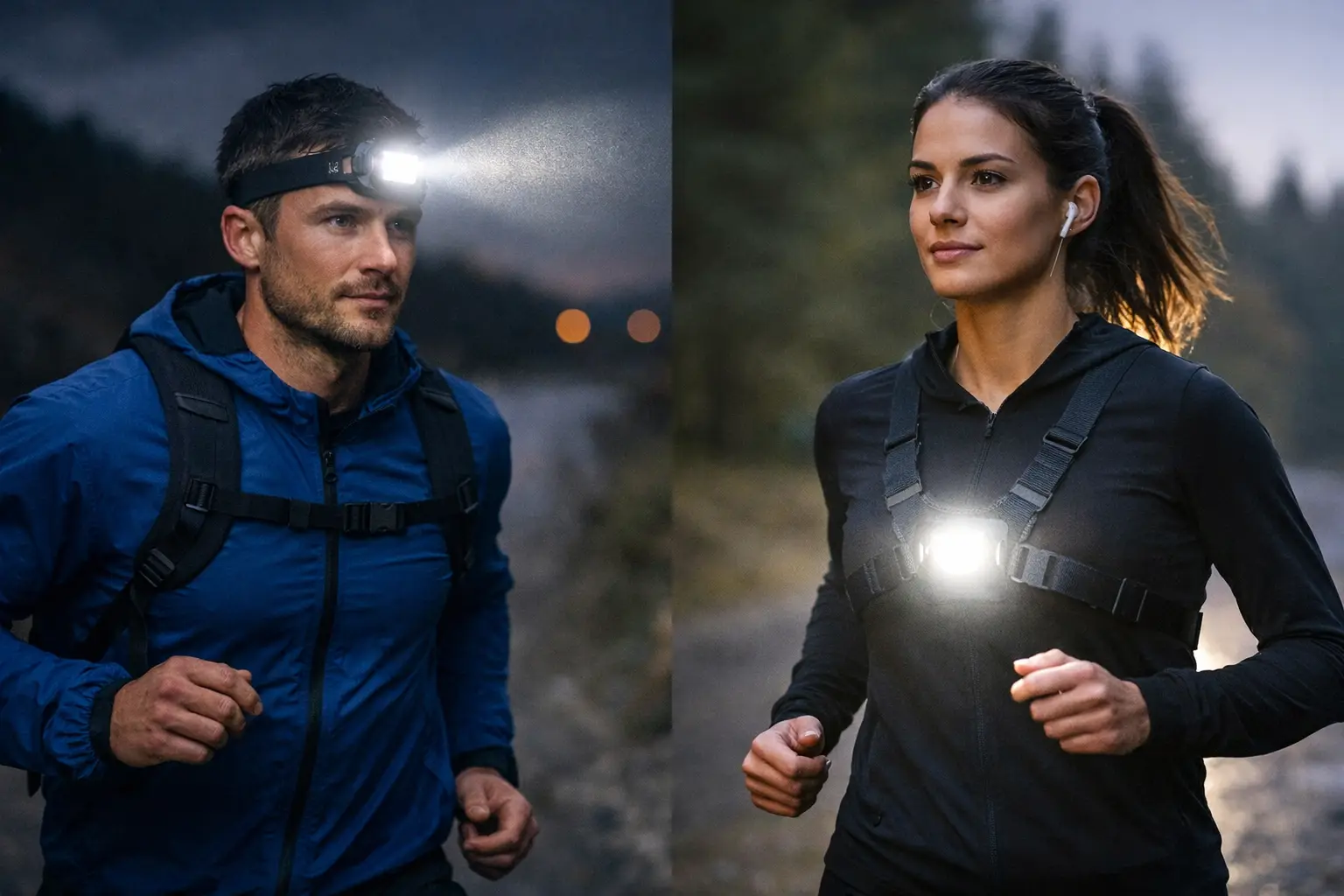
If you have ever hit a dark lane, park path or winter pavement and felt your pace change for the wrong reasons, you already know this is not a small gear choice. The head torch vs chest light debate matters because the wrong light can bounce, glare, distract you or leave key hazards in shadow when you need confidence most.
For runners, visibility is not just about being seen. It is about seeing properly, moving naturally and finishing the session without fighting your kit. That means the better option depends less on marketing claims and more on how, where and when you run.
Head torch vs chest light: what really changes on the run
A head torch throws light from your eye line. Wherever you look, the beam follows. That sounds like an obvious win, and on technical ground it often is. If you are scanning a trail, checking a turn, or looking further ahead on an unlit stretch, a head torch gives immediate control.
A chest light sits lower, usually around the sternum. That lower angle changes what you see. Instead of flattening the ground in front of you, it can reveal texture, kerbs, potholes and uneven surfaces more clearly because the light hits them from below your line of sight. For road and mixed urban running, that can feel surprisingly natural.
The trade-off is simple. A head torch is better at directing vision. A chest light is often better at showing surface detail close to your feet. Neither is automatically best for every runner.
When a head torch is the better choice
If your route changes often, a head torch gives you freedom. You turn your head, the beam turns too. That helps when you are cornering, checking side paths, spotting branches, reading trail markers or looking further ahead on descents.
It also suits runners who need to react quickly to changing terrain. On trails, in woodland, or on rural roads with poor lighting, that ability to point light exactly where your attention goes is hard to beat. You are not waiting for your body to line up with what your eyes are doing.
There is another advantage. A head torch usually projects farther. If you run faster, that matters. At a stronger pace, seeing two or three strides ahead is not enough. You want enough beam distance to plan foot placement and hold rhythm rather than constantly braking.
But there are drawbacks. Some runners dislike any weight on the head, especially over longer distances. If the strap is poor, the beam can bob with each step, which becomes irritating quickly. There is also the issue of glare. On roads, a bright head torch can shine directly into the eyes of pedestrians, cyclists and other runners if you are not careful. Good kit and good habits help, but it is still something to manage.
When a chest light makes more sense
A chest light can feel more stable from the first mile. Because the light sits on the torso, there is no pressure around the forehead and no beam movement caused by every glance. For runners who hate the feeling of something strapped to the head, this alone can decide it.
The lower beam angle is the big reason many road runners prefer it. Cracks in pavement, puddles, loose gravel and raised edges often stand out better when lit from chest height. You get more definition in the surface immediately ahead, which can make steady running feel safer and smoother.
It is also a strong option for runners who want visibility without fuss. Many chest lights combine forward lighting with rear red lights or reflective detailing, which helps you stand out from more angles in traffic. On commuting routes, suburban roads and regular evening loops, that practical all-in-one setup is useful.
Still, chest lights are not perfect. The beam only points where your torso points, not where your eyes look. If you turn your head to check a bend or look off to the side, the light stays put. On tight trails or more technical ground, that can feel limiting. Fit matters too. If the harness rubs, shifts over layers or bounces on faster sessions, comfort disappears quickly.
Comfort matters more than most runners expect
The best light is the one you will actually wear. That sounds obvious, but many runners buy for brightness and ignore comfort until the first dark run.
A head torch needs a secure but not overly tight fit. Too loose and it bounces. Too tight and it causes pressure across the forehead, especially on longer runs or in cold weather when you are already wearing a hat. Sweat management matters as well. Straps that soak through and stay wet can become annoying in winter.
A chest light needs stable straps and enough adjustability to sit flat over a base layer, jacket or gilet. If it shifts with arm swing or breathing, the beam becomes inconsistent and the run gets frustrating. For many runners, chest-mounted lights feel better over medium distances, but only if the harness is well designed.
This is where durable, runner-focused kit earns its place. Cheap, disposable gear often looks fine on paper and fails where it counts – fit, battery life, weather resistance and long-term reliability. Better gear costs less in the long run when it lasts and keeps doing the job.
Brightness is not everything
Runners are often pushed towards higher lumen numbers, but more brightness is not always more useful. The right beam shape matters just as much.
A narrow, intense beam can help you see farther, which suits faster efforts and darker routes. A wider beam can improve peripheral awareness and make near-ground hazards easier to read. For many everyday runners, balanced lighting beats maximum output.
There is also the issue of battery life. If a light only delivers its headline brightness for a short burst, that spec is less helpful than it seems. A consistent, reliable output for the full run is more valuable than a high number that drops quickly. If you run before work, after work or several times a week through winter, rechargeable kit with dependable runtime is usually the smarter choice.
Which is safer in traffic?
If your main concern is being seen by others, the answer is often not either-or. A forward-facing light helps you see, but visibility to drivers, cyclists and other path users comes from your whole setup.
A chest light often has an advantage because it sits at a level that is more immediately visible to oncoming traffic and can be paired easily with rear lighting and reflective straps. It creates a clearer signal of a moving runner, especially on roads and crossings.
A head torch can also improve your presence, particularly because the moving beam draws attention. But if it is your only visibility tool, it leaves gaps. Drivers do not just need a bright point. They need a clear sense of where you are and how you are moving.
For road runners, the safest approach is usually layered visibility: active lighting plus reflective elements. Seeing and being seen are related, but they are not the same thing.
Head torch vs chest light for different types of running
For road running, especially in towns, suburbs and lit or semi-lit routes, a chest light often feels more comfortable and practical. It helps with near-ground hazards and can offer better all-round visibility in traffic.
For trail running, a head torch usually takes the lead. The ability to direct light with your gaze is a real advantage when footing changes constantly and the route is less predictable.
For mixed routes, it depends on what dominates the run. If most of your miles are pavement with the occasional dark section, a chest light may be enough. If the route includes unlit turns, rough paths or sharper changes in terrain, a head torch is likely to serve you better.
Pace matters too. Faster runners often benefit from a head torch’s longer throw. Steadier runners on familiar routes may prefer the easy wear of a chest light.
So which should you choose?
Choose a head torch if you run trails, need more control over where the beam goes, or want stronger distance visibility for faster running. Choose a chest light if you mostly run roads, value comfort, and want a lower beam angle that picks out the ground in front of you more clearly.
If you run in several conditions, the answer may be both – not as excess, but as sensible kit for different jobs. That is not wasteful when the products are built to last, used regularly and chosen with purpose. Buying one dependable piece of gear that suits your real running life will always beat a drawer full of forgettable accessories.
Dark runs can be some of the best runs of the week – quieter streets, sharper focus, less heat, more headspace. Pick the light that lets you move with confidence, and the miles after sunset start feeling like an advantage rather than a compromise.