

Blog
What Should Runners Wear at Night? A Safe Kit

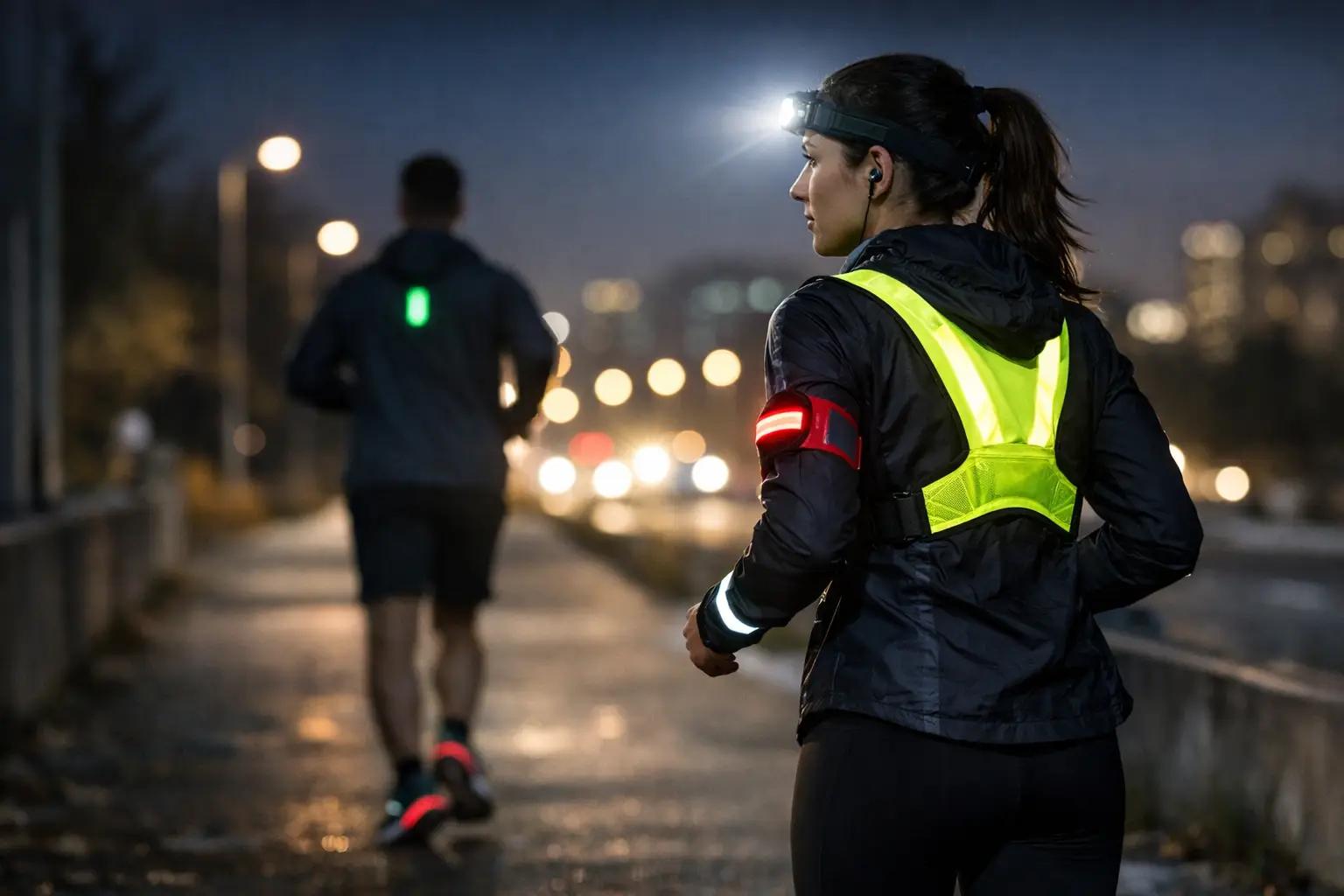
A dark road can make a familiar route feel completely different. If you are asking what should runners wear at night, start with one rule: wear gear that helps other people see you early, while keeping you comfortable enough to run naturally.
That means more than throwing on a pale T-shirt. Street lighting can be patchy, wet roads can swallow light, and drivers may be looking through rain, glare or tired eyes. Your kit should make you visible from the front, back and sides, without leaving you overheated, restricted or weighed down.
What should runners wear at night?
The best night-running kit combines three jobs: it manages your temperature, catches light and creates its own light. Reflective clothing handles the second job. A proper running light handles the third. Both matter because they work differently.
Reflective details shine when a car headlight, bike light or streetlight hits them. They are highly effective in the right conditions, but they do not announce your presence on an unlit path before another light reaches you. An LED chest light or headtorch makes you visible sooner and lets you see kerbs, potholes and uneven ground ahead.
For most evening runs, begin with a breathable base layer or technical running top, add a weather-appropriate outer layer, then build visibility over it with reflective straps or a lightweight reflective vest. Finish with a front-facing light and a rear light where the route, weather or traffic calls for it.
There is no need for a separate, disposable outfit for every season. Choose durable layers that work on dawn runs, dark winter evenings and low-light walks too. Gear with a genuine job earns its place in your wardrobe.
Start with breathable, weather-ready layers
Night often means cooler temperatures, but do not dress for the first five minutes. Dress for the effort you will be putting in after ten. A sweat-soaked cotton top can become cold and heavy, particularly in Northern Irish drizzle or a sharp crosswind. Technical fabrics that move moisture away from the skin are the better choice.
In mild conditions, a breathable short-sleeve or long-sleeve top may be enough. When the temperature drops, use a light long-sleeve base layer under a wind-resistant running jacket. The jacket should protect you from wind and showers without trapping heat. If it is properly cold, gloves and a thin running hat can make a far bigger difference than piling on a bulky extra layer.
Your lower half needs the same practical thinking. Running tights are useful in cold, wet weather and can provide a little more coverage for reflective detailing. Shorts are still perfectly workable on a mild evening, provided your upper body and accessories make you easy to spot. Comfort is a safety feature too: if seams chafe, waistbands slip or fabric restricts your stride, your focus comes off the road.
Make your whole body visible, not just your chest
A small reflective logo is better than nothing, but it is not a night-running strategy. Look for reflective elements that can be seen as your body moves: straps across the torso, bands at the wrists or ankles, and details on the front and back.
Movement helps others recognise that you are a person, rather than a static roadside object. Reflective ankle and wrist points can be especially useful because the swinging motion catches attention. A reflective vest with adjustable straps is a practical option over any running top or jacket, so one dependable piece can work across seasons rather than forcing you to replace good clothing.
Bright colours can improve contrast in twilight and daytime rain, but colour is not a substitute for reflectivity or lighting after full darkness. Fluorescent yellow, orange and pink rely on daylight to pop. Once the light fades, a black jacket and a fluorescent jacket can both disappear unless they include reflective material or you wear active lights.
Use a light that helps you see and be seen
A rechargeable LED chest light is often the most straightforward choice for road and pavement running. It puts a beam ahead of you, keeps your hands free and can make your movement more obvious to traffic. A rear red light adds a clear signal for anyone approaching from behind.
A headtorch can be excellent for trails, parks and uneven ground because its beam follows where you look. The trade-off is that a poorly fitted headtorch can bounce, feel distracting or create glare when you glance at another runner. Whichever light you choose, test its fit before committing to a long run.
Do not wait for the battery to fail halfway through a dark route. Charge your light after use or make it part of your pre-run routine. Check that the beam is clean, the housing is secure and the light has a setting suited to your route. A flashing mode can draw attention in busy urban areas, while a steady beam is often more comfortable for seeing the surface ahead. Use judgement: on a shared path, an overly powerful beam pointed at eye level is unpleasant for everyone coming towards you.
For a completely unlit route, use both a light that illuminates the ground and reflective gear that returns other people’s light. One cannot fully replace the other.
Choose fit that will not distract you
Night-running gear must stay where you put it. A bouncing chest light, twisting vest strap or loose armband soon becomes irritating, then unsafe. Adjust everything while wearing the layers you will actually run in. Take a few strides, swing your arms and check that the kit does not rub around the neck, ribs or underarms.
If you carry a phone, keys or a gel, use secure pockets or a close-fitting running belt. Avoid stuffing hard items into loose jacket pockets where they can bounce. No-tie elastic laces are another small but worthwhile upgrade for runners who want a secure fit without stopping under a streetlamp to deal with a loose knot.
Footwear deserves attention as well. Wear shoes with grip appropriate to the ground, especially when leaves, rain, frost or mud are involved. Darkness makes wet paint, broken paving and slick drain covers harder to read. Your light helps, but secure shoes and a sensible pace remain essential.
Adapt your kit to the route
A lit town-centre pavement, a quiet country lane and a muddy trail ask for different choices. There is no single uniform that makes every after-dark run safe.
On a well-lit urban route, reflective straps and a visible front and rear light may be enough, with breathable layers suited to the temperature. On country roads, increase your visibility and favour a route with a pavement where possible. If there is no pavement, run facing oncoming traffic where it is safe to do so, stay alert and give vehicles plenty of space. Never assume that being visible means a driver has seen you.
For trails and parks, prioritise a reliable forward beam, stable shoes and enough battery for delays. Let someone know where you are going if the route is isolated. In heavy rain or fog, visibility drops dramatically for everyone. Choose brighter active lighting, shorten the route or use a better-lit alternative. Turning back is good judgement, not a missed session.
Buy less, choose better for night runs
Night running should not require a pile of novelty gear that fails after a few outings. Fast-fashion sportswear creates needless waste, and cheap visibility accessories can be unreliable at the moment you need them most. Buy purposefully: a durable reflective layer, a rechargeable light and comfortable technical clothing will cover a huge number of runs.
Look after that kit as well. Wipe mud and sweat from lights, recharge them properly, inspect straps for wear and wash technical fabrics according to their care instructions. Replacing only what is genuinely worn out is better for your budget and the planet.
At 4R, that is the standard we believe runners deserve: dependable, functional gear that supports the miles ahead without treating the planet as an afterthought.
The goal is not to look like a Christmas tree. It is to give yourself the freedom to run when the day is done, knowing you can see the route, be seen by others and focus on the feeling that brought you out in the first place.