

Blog
Running Headlamp Review for Safer Night Runs

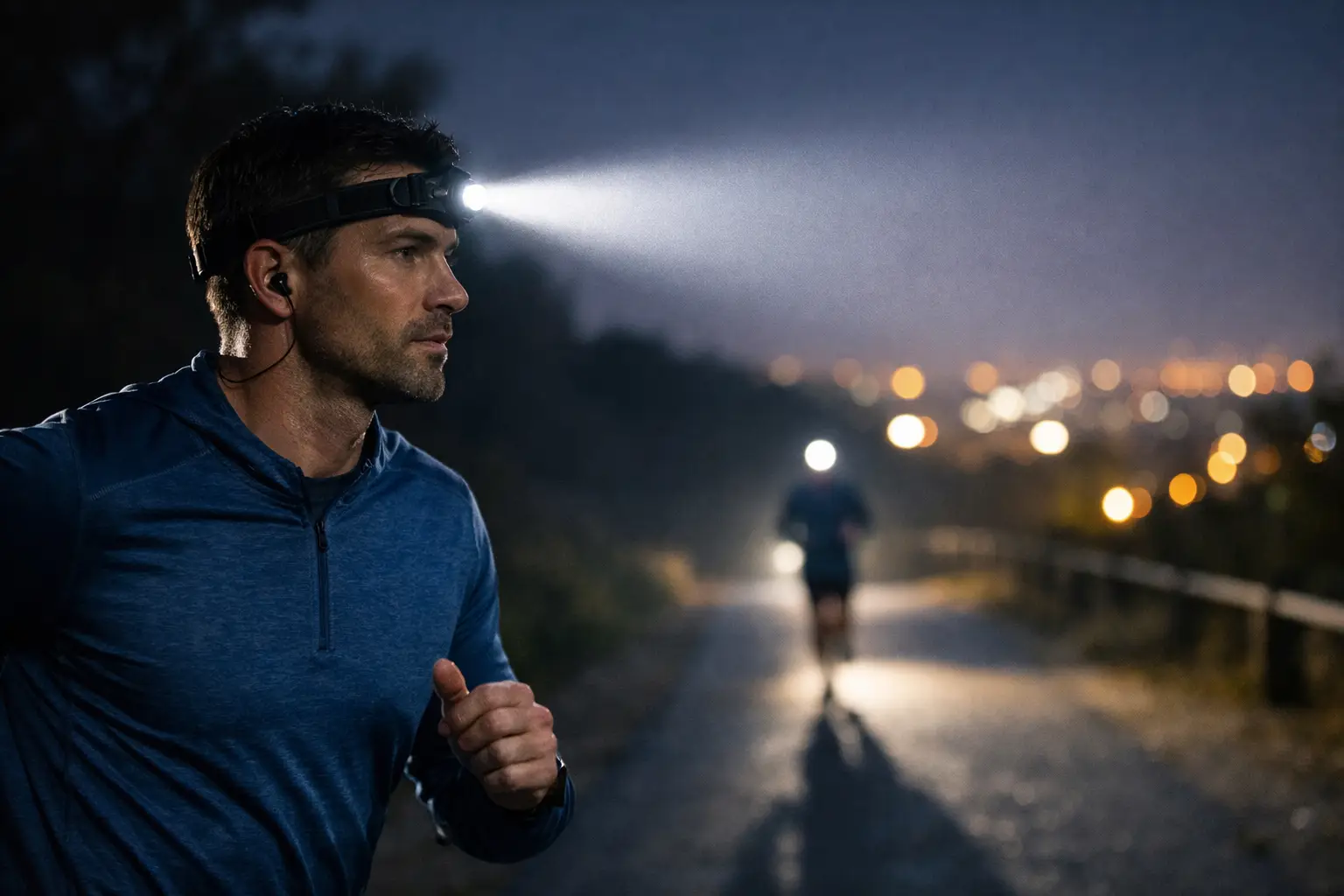
The best night runs often begin when the streets are quiet, the air is cooler and your working day is finally behind you. But darkness changes the job of every piece of kit you wear. A running headlamp is not a flashy extra. It is what lets you spot broken pavement, read a muddy trail and make your position clear to others.
This running headlamp review focuses on what genuinely earns a place in a runner’s kit bag: useful light, a secure fit, dependable charging and a design built for repeated miles rather than a few novelty outings. The right choice depends on where, when and how you run. More lumens are not automatically better. Neither is the lowest price if the unit fails halfway through a winter session.
Running headlamp review: what matters on the run
A headlamp has two jobs. It must help you see what is ahead, and it must help others see you. Those needs overlap, but they are not identical.
On an unlit woodland path, seeing roots, puddles and changes in ground level is the priority. You need a purposeful forward beam with enough reach to react at your natural pace. On a lit urban route, your main concern may be being noticed by drivers, cyclists and other pedestrians. A lower forward setting, combined with reflective details or a rear light, can make more sense than blasting a powerful beam into everyone’s eyes.
That distinction is worth making because night-running gear is often sold on one big number: lumens. Lumens describe total light output, not how useful that light will feel on your route. Beam shape, light temperature, angle and runtime are just as important.
Beam quality beats a headline lumen number
For road running under streetlights, a modest setting is usually enough to illuminate uneven kerbs and poorly lit sections. A broad, even beam is more comfortable than a narrow spotlight that creates a bright circle and leaves everything around it in shadow.
For trails, a stronger beam with a longer throw gives you more time to identify obstacles. If you run technical ground at speed, look for adjustable brightness rather than one fixed, ultra-bright mode. The highest output is useful for short, difficult stretches, but it drains the battery faster and may be unnecessary on open fire roads or familiar paths.
A useful headlamp lets you switch modes quickly with cold fingers or gloves. It should also angle down without slipping, so the beam lands a few metres ahead rather than lighting up the mist, rain or treetops. That is a small detail until you have spent an hour constantly pushing the lamp back into position.
A stable fit protects your focus
The most powerful light in the world is frustrating if it bounces with every stride. Head-mounted units need a strap that adjusts easily and holds firm without creating pressure points across the forehead. Wider elastic generally spreads the load more comfortably, especially on longer runs.
Weight matters too. A compact rechargeable unit can feel almost invisible on a steady 5K around town. Add a larger battery, however, and you may notice the lamp pitching forward or rubbing under a hat. For regular road running, lighter is often better. For long trail sessions, a slightly heavier lamp may be worthwhile if it delivers the runtime you actually need.
Try to judge fit in the conditions you run in. A lamp that seems fine indoors can behave differently over a wet buff, under a hood or when sweat begins to build. If you wear glasses, check that the beam angle does not create glare or reflection in the lenses.
Battery life: plan for the real setting
Manufacturers commonly quote impressive runtimes, but those figures often refer to the lowest setting. That is not misleading if it is stated clearly, but runners should buy according to the mode they will genuinely use.
If your usual winter loop takes 45 minutes, choose a headlamp that can comfortably exceed that on its practical medium setting. Leave room for a delayed finish, colder weather and battery ageing. Lithium batteries lose performance in low temperatures, and a claimed two-hour runtime can be less reassuring when the thermometer drops towards freezing.
USB-rechargeable models suit most everyday runners. They reduce the waste and cost of disposable batteries, and they are simple to top up after a session. The responsibility is equally simple: charge it before you need it. A quick check before leaving the house is better than discovering a flashing low-battery warning on a dark lane.
For longer adventures, overnight events or remote trails, consider whether the battery can be replaced or whether you can carry a backup light. A small secondary light is sensible insurance, not overkill, when darkness and poor weather could leave you far from home.
Weather resistance is not optional
British and Irish runners do not get to wait for perfect weather. Rain, road spray, sweat and mud are part of the season, so a headlamp should be made to handle them.
Look for a stated water-resistance rating, but read it with common sense. Protection from rain is not the same as being safe to submerge in a stream. Pay attention to the charging port cover as well. A loose cover can become an easy entry point for moisture and grit.
Durability also means a housing and strap that cope with being stuffed into a running belt, dropped on a path or used several times a week. Cheap, disposable kit has a habit of becoming expensive when it needs replacing every winter. Buying fewer things that work properly for longer is better for your running budget and the planet.
Headlamp or chest light for running?
A headlamp directs light where you look. That is its biggest advantage on twisting trails, at junctions and when you need to scan around quickly. It is also easy to wear with a reflective vest, jacket or hydration pack.
A chest light sits lower, which can make surface texture and shadows easier to read. Some runners find it more stable and less tiring than having weight on the head. Others dislike the bulk across the torso, particularly when layering up in cold weather.
There is no universal winner. A headlamp is usually the simplest all-round option for road, park and trail running. A chest light can be excellent for regular off-road miles. For genuinely dark, technical terrain, experienced runners may use both, with one light providing distance and the other improving depth perception. That is not essential for everyone, but it demonstrates a useful point: visibility kit should match the route, not social media trends.
Build a visibility system, not just a bright spot
A white beam tells you where you are going. It does not always tell a driver approaching from behind that you are there. Pairing a headlamp with reflective straps, reflective clothing and a rear-facing red light creates a more complete presence on the road.
Reflective material works brilliantly when headlights hit it, but it does nothing in complete darkness without another light source. Active lighting makes you visible sooner. Together, they cover more situations than either one alone.
Avoid assuming that high-visibility colour is enough after sunset. Fluorescent fabric is designed to stand out in daylight and low light. At night, active LEDs and reflective elements do the heavier lifting. Position them where movement helps catch attention, such as your torso, arms or ankles.
The value test: buy for repeated use
A dependable running headlamp should feel like a long-term piece of gear, not a seasonal impulse purchase. Before choosing, ask a few practical questions. Will it stay comfortable for the length of your normal run? Can you operate it without stopping? Is the battery adequate on the setting you need? Does it work in wet weather? Can you combine it easily with the layers and visibility gear you already own?
Paying for features you will never use is wasteful, but buying the cheapest possible light can be a false economy if it is poorly balanced, hard to charge or unreliable in rain. The sweet spot is practical performance: enough light, enough battery, a secure fit and materials made to keep going.
At 4R, we believe runners deserve gear that earns its place. From Newry to night routes across the UK, Europe and beyond, that means choosing functional equipment designed for real movement, real weather and more miles – without feeding the throwaway cycle.
Your dark-season run does not need to feel limited by the clock. Charge your light, check your route, make yourself visible and head out with the confidence to keep moving.