

Blog
When Should Runners Wear Lights?

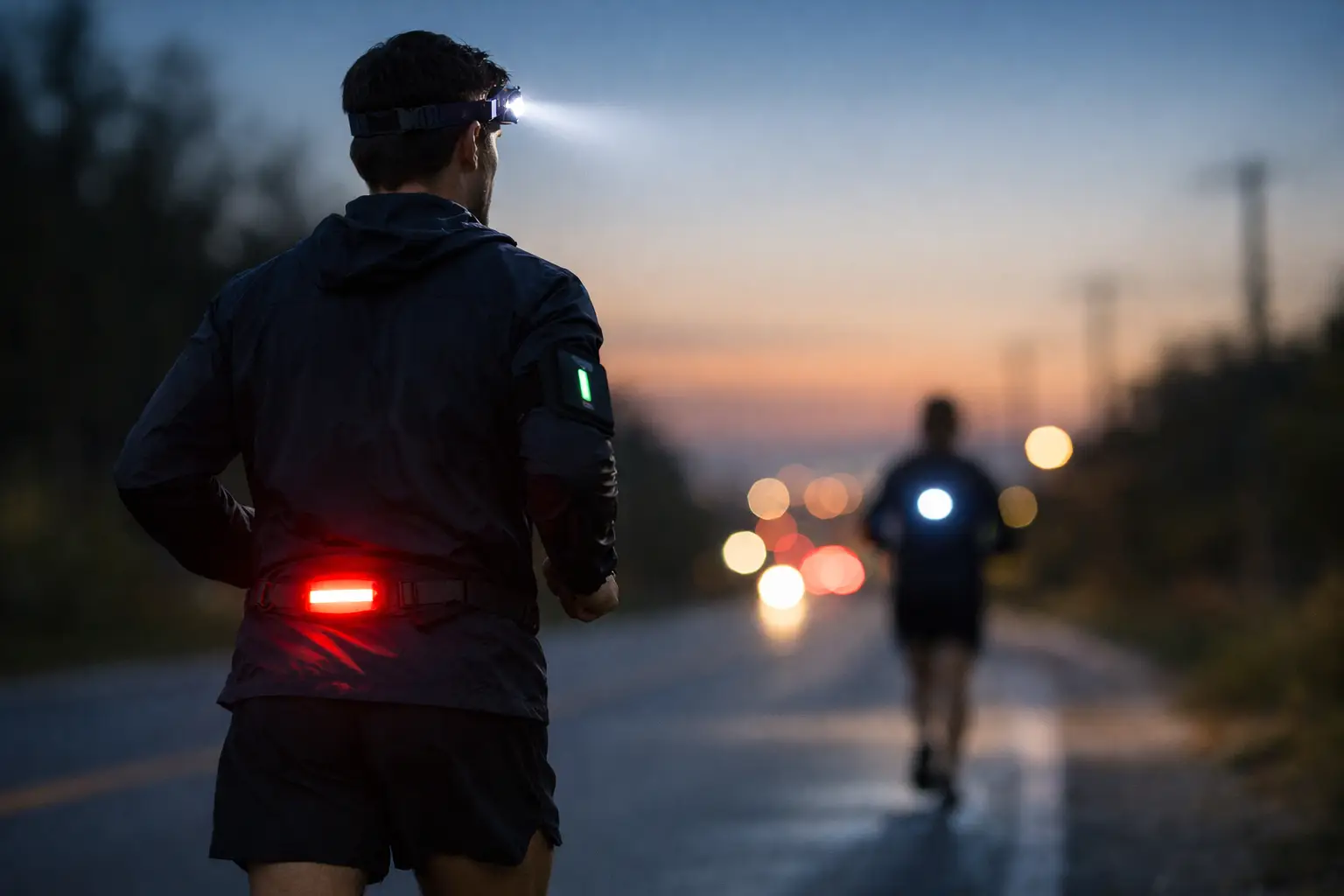
You do not need to wait for full darkness to think about visibility. If you have ever stepped out for an early run and realised the road looked much dimmer than it did from your kitchen window, you already know the answer to when should runners wear lights: earlier, and more often, than most people think.
For everyday runners, lights are not a dramatic extra. They are practical kit. They help you see where you are going, but just as importantly, they help other people see you – drivers, cyclists, dog walkers and other runners. That matters on winter commutes, on quiet country lanes, in city parks at dawn and even on grey, wet afternoons when everything around you blends into the road.
When should runners wear lights in real life?
The simplest rule is this: wear lights any time visibility is reduced. That includes obvious situations like running at night, but it also covers dawn, dusk, fog, heavy rain and gloomy winter days.
Many runners leave lights too late because they judge conditions based on whether they can still see. That is only half the job. A driver turning through drizzle at 5 pm might see the pavement, the traffic lights and the parked cars, but still miss a runner in dark kit. Visibility is not just about your eyesight. It is about contrast, motion and how quickly someone else can identify you.
If your run starts in daylight but ends in fading light, wear them from the start. If the weather forecast is poor, wear them. If your route includes roads, crossings or shared paths, wear them. It is a small decision that removes a lot of risk.
Low light is not just night-time
This is where runners often get caught out. Full darkness is obvious. Low light is trickier because it feels manageable until it suddenly is not.
Dawn and dusk are two of the biggest danger zones. At those times, the light is changing fast. Drivers are adjusting to glare, shadows and patchy visibility. Your eyes might feel comfortable, yet you can still disappear against hedges, wet tarmac or a line of parked cars.
Winter adds another layer. In the UK, plenty of people run before work or after work in months when daylight is short and weak. Even at mid-afternoon, overcast skies can flatten everything. Black leggings and a dark jacket might look sharp, but they do not help much when conditions are dull.
Poor weather counts too. Rain, mist and fog reduce distance vision and create glare from headlights and street lamps. Wet roads reflect light in ways that make it harder for drivers to pick out movement. In those conditions, lights do more than reflective details alone.
Seeing and being seen are different jobs
A lot of runners think one bright headlight solves everything. Sometimes it does a lot, but there is a difference between lighting your path and making your body recognisable to others.
A head torch or chest light helps you spot potholes, kerbs, puddles and uneven ground. That matters on trails, unlit pavements and country roads. But forward-facing light mainly helps you see.
To be seen properly, you also need visibility from different angles. Reflective straps, rear lighting or wearable LEDs on your torso create a clearer outline of a moving person. That is often more useful to road users than a single beam alone. If your route includes traffic, side roads or crossings, think in 360-degree terms rather than relying on one light source.
This is also where trade-offs come in. A very powerful light can be brilliant on dark routes, but too strong for busy shared paths if it dazzles other people. The best choice depends on where you run, how fast you move and what kind of surfaces you cover.
Routes matter as much as time of day
Not every run needs the same setup. A well-lit urban route at 7 am is different from a canal path, and both are different from a rural lane with no pavement.
If you run in towns or cities, street lighting may give a false sense of security. You still need to stand out at crossings, junctions and entrances where drivers are scanning for cars first and people second. A compact chest light or reflective vest straps can make a big difference without adding much bulk.
If you run on trails or dim paths, lights become much less optional. Tree cover, muddy ground, roots and uneven surfaces can turn a familiar route into a hazard in low light. Here, stronger illumination is about performance as well as safety. You run better when you can read the terrain instead of guessing.
If you run on country roads, lights are essential. There may be no pavement, no street lighting and very little time for a driver to react. In those settings, front and rear visibility are worth treating as standard kit, not a seasonal extra.
When reflective gear is enough – and when it is not
Reflective gear has real value, but it works best when light hits it. That means headlights, street lighting or another direct light source. On a dark path with no traffic, reflective details do very little until someone is already close.
That is why active lighting matters. LEDs and rechargeable running lights create visibility instead of waiting for it. They are especially useful in areas with patchy lighting or low traffic, where there may be nobody around to illuminate reflective trim.
The strongest approach is usually a combination. Reflective elements help from a distance when lights catch them. Active lights help in darker gaps and make your movement more obvious. Together they cover more situations with less guesswork.
For runners who care about buying less and buying better, this matters. One reliable, rechargeable setup used regularly is far more practical than a drawer full of throwaway accessories that fail when you actually need them.
Signs you should wear lights, even if you are unsure
If you are debating it, that often means the answer is yes. Still, a few practical checks make the decision easier.
Wear lights if cars have their headlights on. Wear them if the sky is grey enough that colours look muted. Wear them if parts of your route pass under trees, through tunnels, along water or beside fast roads. Wear them if you expect to be out longer than planned. And wear them if you are dressed in darker winter kit, which most runners are.
It is also worth thinking about pace and fatigue. Late in a run, form gets looser and concentration dips. On dim routes, that is exactly when better visibility helps most. Lights are not just for the start of your run. They protect you when you are tired and less sharp too.
Choosing lights you will actually use
The best running light is the one you will wear every time conditions demand it. That sounds obvious, but comfort and convenience matter. If a light bounces, chafes, slips or needs constant battery changes, many runners stop using it.
Look for kit that feels stable and simple. Rechargeable options are usually the strongest fit for regular runners because they cut waste and remove the hassle of buying disposable batteries. A chest-mounted light can feel more natural for some runners than a head torch, especially if they dislike pressure around the forehead. Reflective vest straps work well when you want visibility without a heavy extra layer.
Brightness matters, but so does usability. You need enough output for your route, not just the highest number on a box. If you mostly run in built-up areas, comfort and visibility may matter more than a huge beam. If you run off-road or on unlit roads, stronger forward light becomes more important.
This is where thoughtful kit earns its place. Durable, rechargeable gear that works across seasons supports both performance and a more responsible way to buy. That is a far better approach than treating safety accessories as cheap, disposable add-ons.
Build the habit before you need it
The smartest runners do not make the decision at the front door every time. They build a routine. If a run is scheduled for early morning, evening or questionable weather, lights go on automatically. No debate. No hoping conditions will improve.
That habit matters because visibility can change mid-run. Daylight drops. Rain moves in. A route that looked fine at the start becomes dim on the return leg. When your lights are already part of your setup, you are ready for the run you actually get, not just the one you planned.
There is also a confidence boost that comes with being properly equipped. You move more freely when you are not second-guessing each crossing or squinting at dark patches ahead. Good running gear should do exactly that – remove friction, support your effort and keep you moving with purpose.
If you want one clear answer to when should runners wear lights, use this: any time someone could struggle to see you, or you could struggle to read the ground ahead. That is not overcautious. It is what smart, consistent running looks like. And if a small piece of reliable kit helps you run safer, longer and with less waste, that is a decision worth making before the light fades.