

Blog
Guide to Reflective Gear Standards for Runners

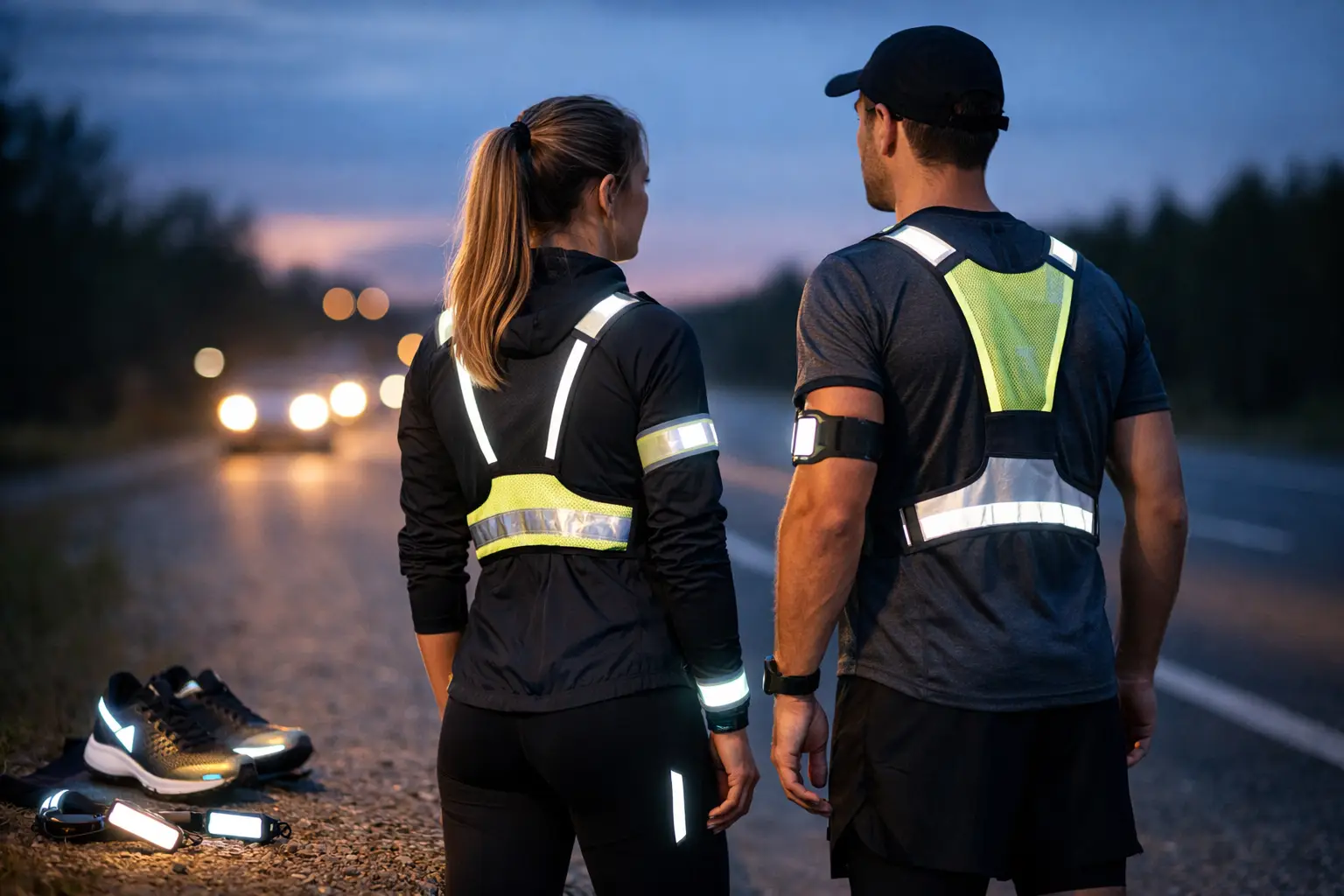
A wet winter evening outside Newry can make a familiar road feel very different. Headlights flare on puddles, dark pavements swallow contrast and a runner in black can disappear until the last second. This guide to reflective gear standards cuts through the labels, so you can choose kit for genuine visibility rather than a shiny-looking gimmick.
Reflective gear is not one single category. A reflective vest strap, a high-visibility jacket and an LED chest light all help drivers notice you, but they work in different conditions and may be covered by different standards. Knowing the distinction helps you buy less, choose better and keep dependable equipment in use for longer.
What reflective standards are actually measuring
Most reflective materials are retroreflective. Instead of producing their own light, they return light from a vehicle’s headlamps towards its source. That is why a reflective strip can look dull under a street lamp but flare brightly when a car approaches.
Standards test how effectively a material reflects light under controlled conditions. They can also set requirements for the amount, placement, durability and visibility of fluorescent or reflective material on a garment. A compliant standard is useful evidence, but it is not a promise that every road user will see you instantly. Rain, grime, a backpack, poor fit, bends in the road and a driver’s attention all change the result.
Fluorescent fabric and reflective trim solve different problems. Fluorescent yellow, orange or pink helps you stand out in daylight and overcast conditions. Retroreflection is the stronger tool after dark when vehicle lights are present. LEDs create their own light, which can be especially useful on unlit routes, but they need charging and should not be treated as a replacement for reflective coverage.
Guide to reflective gear standards: the labels to know
For runners in Great Britain and Europe, these are the standards you are most likely to encounter. The right one depends on the product’s intended use, not on how bright its marketing photography looks.
EN ISO 20471: occupational high-visibility clothing
EN ISO 20471 is the best-known high-visibility clothing standard. It is designed for professional settings where people work near traffic or other hazards. It specifies three classes, with Class 3 providing the greatest minimum area of fluorescent background and retroreflective material.
That does not mean every runner needs a Class 3 jacket. These garments can be excellent for winter commuting or route marshal duties, but they may be warmer, bulkier and more than you need for a short run on well-lit streets. If a product claims EN ISO 20471 compliance, check that the claim applies to the finished garment, not merely to its reflective tape.
EN 17353: enhanced visibility for non-professional use
EN 17353 is often more relevant to everyday runners, walkers and cyclists. It covers enhanced-visibility equipment for medium-risk situations rather than occupational personal protective equipment.
The standard separates visibility by condition. Type A focuses on daytime visibility using fluorescent material. Type B focuses on darkness using retroreflective material, while Type AB combines both. You may also see Type B categories that distinguish between free-hanging accessories, attached accessories and garments.
For an after-work road run, a Type B or Type AB product can make practical sense. The crucial question is still where the material sits. Reflective elements on the chest, back, shoulders and moving limbs are easier to recognise than a tiny patch hidden low on the body.
EN 1150: high-visibility clothing for non-professional users
EN 1150 is an older standard for non-professional high-visibility clothing that may still appear on existing stock or product information. It was created for users such as runners, cyclists and children rather than workplace wearers. In many cases, EN 17353 is now the more current reference for enhanced-visibility gear.
If you see EN 1150, do not assume the product is ineffective. Treat it as a prompt to look at the garment’s condition, coverage and intended use. Standards evolve, while a well-made, properly maintained piece of kit can remain useful for years.
EN 13356: reflective accessories
EN 13356 covers retroreflective accessories for non-professional use. Think bands, hanging tags, wrist straps and similar add-ons. It is particularly relevant if you prefer a lightweight reflective vest strap over another full running top.
Accessories are brilliantly versatile. You can put them over your usual running layers, which avoids buying separate outfits for every season. Their limitation is coverage: a narrow band cannot provide the same all-round visual signal as a high-visibility jacket. Pairing a reflective accessory with brighter clothing and a light is often the more sensible system.
Do not confuse a material claim with a product certification
A common grey area is the phrase “made with reflective material”. It may simply mean that a logo, print or trim catches some light. It does not automatically mean the complete item meets EN 13356, EN 17353 or EN ISO 20471.
Look for a clear statement of the applicable standard and the finished product it covers. For PPE products sold in the EU, conformity information and CE marking may be relevant. In Great Britain, applicable product marking requirements can differ. The paperwork matters most when you need specified workplace protection, but clear, honest product information should matter to every runner.
Be wary of vague claims such as “ultra-reflective” with no indication of test standard, placement or care requirements. The aim is not to turn every purchase into a paperwork exercise. It is to avoid paying for disposable kit whose only safety feature is a buzzword.
Build visibility around your actual route
The best gear choice depends on where and when you run. On a fully lit urban route, a reflective vest strap over a light-coloured top may be enough to add useful contrast. On country lanes, at dusk or in persistent rain, build more redundancy: reflective elements front and back, visibility from the sides, and a rechargeable chest or head light.
Movement is a powerful signal. Reflective details on arms, ankles and lower legs help approaching drivers recognise a human shape sooner than one large, static block of material. That is why straps can be valuable despite their smaller surface area. Use them as part of a system, not as a reason to disappear into all-black layers.
For group runs, avoid overly intense flashing modes that distract people behind you. A steady or gentle pulse is usually easier on fellow runners while still making your position clear. Aim lights downwards rather than straight into approaching faces, and check battery levels before leaving home.
Fit, care and replacement matter as much as the label
A certified jacket worn under a dark coat is not doing its job. Likewise, a loose strap that twists round your back or a chest light that bounces with every stride creates friction you will soon stop tolerating. The most effective kit is the kit you will wear consistently.
Wash reflective garments as directed. Fabric softeners, harsh detergents, high heat and abrasion can reduce the performance of reflective surfaces. Let gear dry fully after rain, wipe mud from reflective panels and inspect cracked prints, peeling strips and damaged fastenings. Rechargeable lights deserve the same routine: keep charging ports dry, inspect straps and replace a fading battery before it becomes a problem mid-run.
Replacement should be based on condition, not fashion seasons. There is no virtue in binning functional gear for the latest colourway. Equally, do not keep relying on a worn-out vest because it once carried a respected standard. Durable equipment is the sustainable choice only while it still performs.
A practical buying check before you run
Before choosing reflective gear, ask three direct questions. First, is it designed for darkness, daytime contrast or both? Second, will its reflective areas remain visible once you add layers, a running belt or a backpack? Third, can you realistically maintain and use it through a full winter?
A well-chosen reflective vest strap, durable light and a few considered layers can cover more conditions than a cupboard full of novelty running clothes. That is better for your budget and better than feeding the fast-fashion cycle with gear that fails after one season.
Your route may be dark, but your presence should never be a surprise. Choose visibility gear with proof behind it, look after it, and let every early start or late finish be a confident one.