

Blog
Guide to LED Light Maintenance for Runners

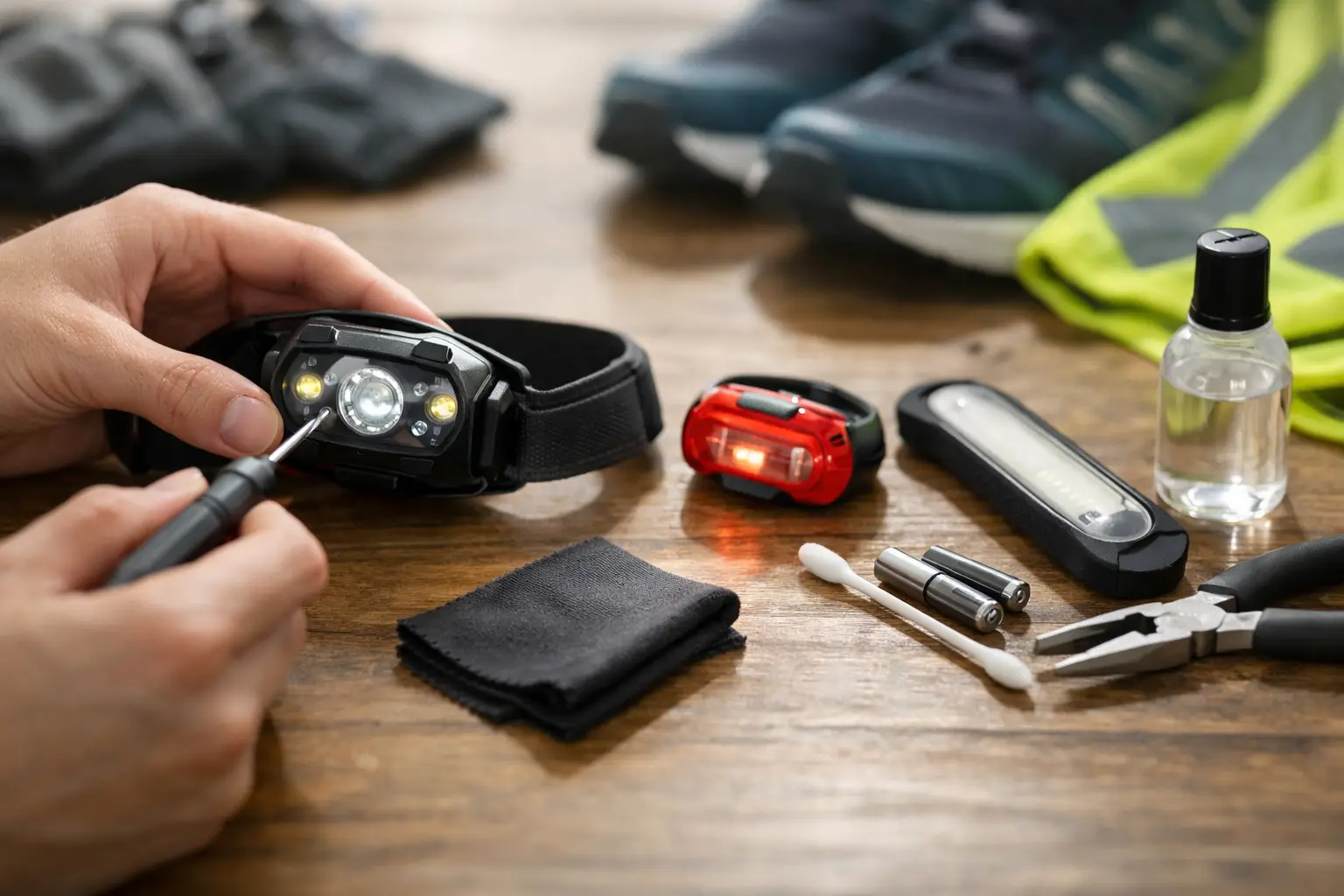
A dark winter morning is the worst time to find that your running light has faded, flickered or refused to switch on. This guide to LED light maintenance helps you avoid that moment. A few simple habits keep your chest light or rechargeable headlight visible when it matters, while helping one dependable piece of kit last far longer.
That matters for your safety, your budget and the planet. Running gear should earn its place in your kit drawer. We do not need more disposable accessories built for a handful of outings and a landfill-bound future. We need reliable gear, looked after properly, that is ready for the road, trail and pavement.
Why LED running lights need care
LEDs themselves can last a long time. In most running lights, the weak points are more likely to be the rechargeable battery, charging port, seals, switch and strap. Sweat, rain, mud and repeated stuffing into a damp running bag can all take their toll.
A light may still turn on while delivering much less useful brightness than it did when new. That is a safety issue, particularly around traffic. If drivers, cyclists and other runners cannot spot you early, the light is not doing its full job.
Maintenance is not about treating functional gear like a museum piece. It is about giving it a quick check after hard use, charging it sensibly and storing it dry. That is enough for most runners.
Guide to LED light maintenance: start after every wet run
Do not leave a soaked light buried in a kit bag. When you get home, switch it off, remove it from your body or clothing and dry the outer casing with a soft cloth. Pay attention to the lens, power button, charging cover and the point where the lamp joins its strap or clip.
If the light has picked up mud, rinse only as far as its water-resistance rating permits. Check the product instructions before putting any electronic light under a tap. Water-resistant does not always mean fully waterproof, and a unit that handles rain may not be designed for submersion.
Let the light air-dry fully before charging it. This is especially important around USB ports. A charging flap closed over trapped moisture can create corrosion over time, while plugging a wet port into power is a needless risk.
Sweat deserves the same attention as rain. It contains salts that can build up around seams, switches and metal contacts. A lightly damp cloth is usually enough to wipe the casing clean. Avoid strong household cleaners, alcohol-heavy sprays and abrasive pads, which can cloud the lens or damage protective coatings.
Keep the lens clear, not scratched
A dirty or scratched lens reduces the useful output of a light, even when the LEDs are working perfectly. Wipe dust and road spray away with a clean microfibre cloth. If grime remains, use a little lukewarm water on the cloth rather than applying cleaner directly to the unit.
Never scrape dried mud off with keys, fingernails or the edge of a tool. Small scratches scatter the beam and can make the light appear duller. If you carry your light loose with coins, gels and keys, give it its own small pouch instead.
Charge for reliability, not convenience alone
Rechargeable running lights are most dependable when you do not repeatedly run them from full charge to completely flat. Charge after a few sessions or after a longer night run, rather than waiting for the warning flash before every recharge.
At the same time, avoid leaving a light connected for days. Modern rechargeable products commonly have protective circuitry, but constant charging creates unnecessary heat and is not a good long-term routine. Disconnect it once charged, then store it somewhere cool and dry.
Use the supplied cable where possible, or a reputable replacement that fits correctly. A loose or damaged cable can cause inconsistent charging and unnecessary wear on the port. If charging becomes unreliable, inspect the cable first. It is often the simplest problem to solve.
For runners who use lights several times a week, choose one fixed charging moment. Sunday evening works well for many people: clean the light, check the strap and top up the battery before the week begins. The best routine is the one you will actually keep.
Watch for changing battery behaviour
A shorter run time is the clearest sign of an ageing battery. Test it at home by fully charging the unit, selecting the brightness mode you normally use and timing how long it stays at a useful output. Do not rely solely on whether it remains technically switched on.
Cold conditions can also reduce battery performance temporarily. If your light seems weak on a freezing morning but returns to normal indoors, temperature may be the reason. Keep it in a pocket or indoors until you are ready to head out, rather than leaving it in a cold shed or car overnight.
If the casing becomes unusually hot, the battery swells, the port smells burnt, or the unit charges erratically, stop using it. Do not try to open or repair a sealed battery pack yourself. Electronic gear has a working life, but it should never be used once it appears unsafe.
Check the fit as carefully as the brightness
A bright light pointing at the ground is less useful than a correctly aimed lower setting. Before an early or evening run, put on your vest, chest light or headlight and check where the beam lands. You want enough forward illumination to see changes in surface, while remaining visible to others without shining directly into their eyes.
Straps stretch with use. Inspect elastic for fraying, cracked adjustment hardware or clips that no longer hold firmly. A bouncing light can chafe, distract you and make its beam harder for approaching traffic to interpret. Adjust the fit over the layers you actually run in, not just a thin top indoors.
For chest-mounted lights, wipe the contact areas and buckles after sweaty runs. For headlights, check that the strap is clean and dry before storing it. Damp elastic develops odours quickly and loses its shape sooner.
Choose the right mode for the route
Maximum brightness is not automatically the best setting. On a dark trail with uneven ground, a stronger forward beam can be sensible. On a lit urban route, a lower steady setting paired with a visible rear light may give you better battery life without compromising awareness.
Flashing modes can help draw attention, but they are not ideal in every situation. A steady beam is often easier for others to judge at night, while an aggressive flash can be uncomfortable for runners sharing a narrow path. Consider your surroundings, not just the specification on the box.
It also pays to check your local race rules if you run organised night events. Some require a minimum lumen output or reserve mandatory lighting for specific sections. A properly maintained light only helps if it meets the conditions of the route.
Store lights so they are ready for the next run
Store your LED light clean, dry and out of direct sunlight. A drawer or cupboard at normal room temperature is better than a windowsill, car glovebox or unheated shed. Heat and cold both put extra strain on rechargeable batteries.
If you will not use the light for several months, do not put it away empty. Charge it partway first, then check it every few months. The ideal charge level depends on the battery and manufacturer guidance, but avoiding a long period at fully flat is a sensible rule.
Keep the charging cable nearby, but do not wrap it tightly around the lamp. Sharp bends weaken cables and can damage the charging cover. A small designated space for lights, reflective straps and other dark-run essentials makes preparation quicker when daylight disappears early.
Know when maintenance is no longer enough
Good maintenance extends life. It cannot reverse a failing battery, a cracked casing or water damage. Replace a light when its practical run time no longer covers your normal route with a sensible safety margin, when its mount will not stay secure, or when the lens and housing are badly damaged.
Before binning electronic gear, check local recycling options for rechargeable batteries and small electrical items. They should not go in ordinary household waste. Responsible disposal is part of buying less, buying better and making every product work as hard as it can.
At 4R, we believe dependable running kit should support your miles without adding to the throwaway cycle. Give your LED light ten minutes of care now and then, and it will be far more likely to show up for you when the road ahead is dark.